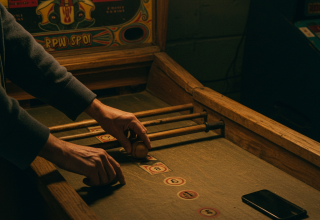
The first Skee-Ball alleys came in two sections. Sixteen feet of lane arrived in one piece and another sixteen in the next. You could put a row of them on a phone screen today and still have room for the ticket counter. The difficult part would be getting a single lane to play right.
The jump at the end of the alley
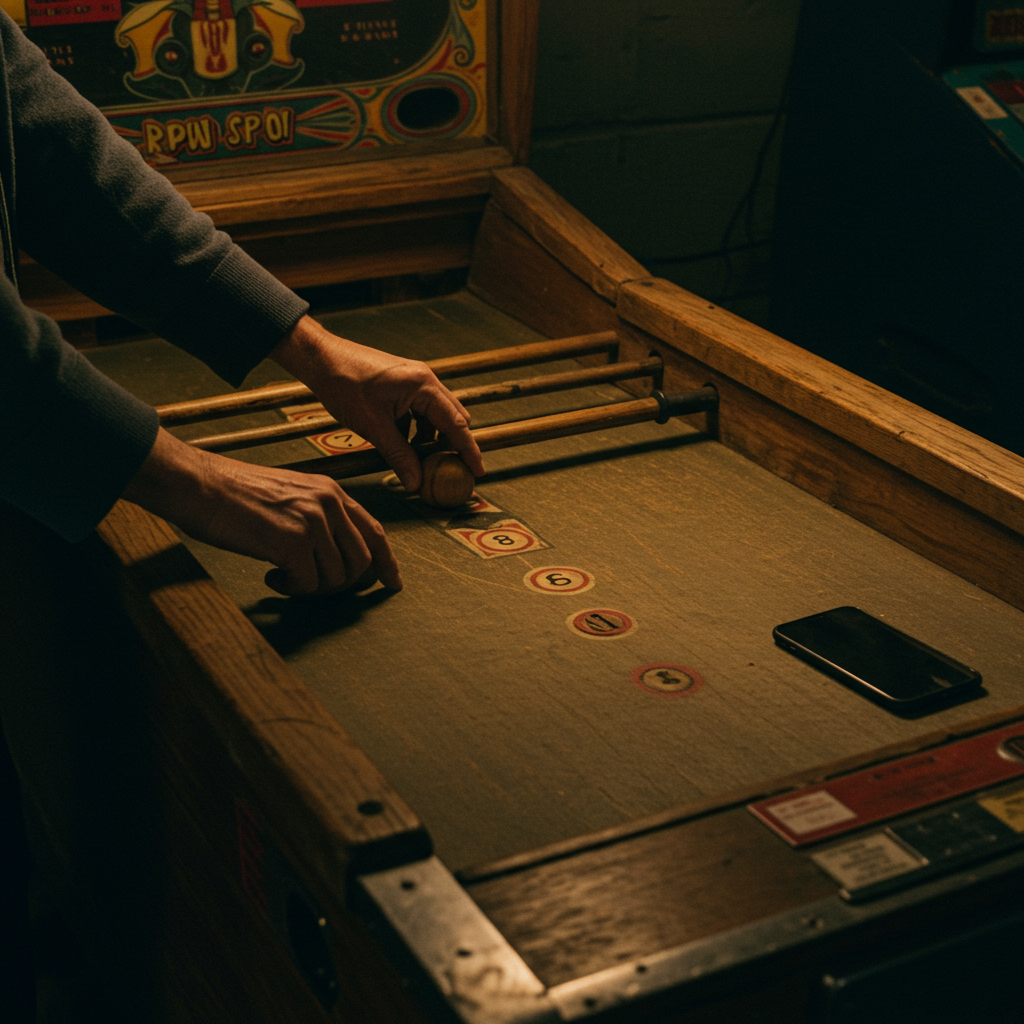
Stand to one side of a Skee-Ball lane in Ocean City, New Jersey, and watch someone else take a turn. From there you can see something the player can easily miss. A ball that looks as though it went straight into the scoring ring may have clipped the rim on the way in. The next throw takes much the same line, catches a little more wood and bounces out. To the person rolling, those two shots can feel awfully alike.
Joseph Fourestier Simpson of Vineland designed a jump that would carry the ball off the lane and into a target equipped to register the score. His patent came through in 1908. The dimensions of the early production alleys turn up in the manufacturer’s history of the game, alongside a detail that sounds familiar to anyone who has ever hauled a pool table upstairs. Even in two pieces, a thirty-two-foot alley is a lot of furniture.
A penny pusher gives the spectator a much worse seat. That coin sticking out over the front is plain enough. What has it pinned there? There might be three other coins resting on its back edge. Feed in a penny on the left and watch one fall on the right. Good luck working out exactly what happened in between through a pane of scratched glass.
A wet afternoon on the Jersey Shore
Going back to the boardwalk for one more game in the rain used to involve a small family negotiation. Who else wants to get their shoes wet? Back at the rental, a phone cuts the journey to a walk across the kitchen for a charger. What the phone loses along the way is the weight of the ball in your palm.
Consider using the distance of a swipe to set the speed of the ball. A slow swipe from the bottom edge to the top would send it up the lane faster than a quick flick that barely covers an inch. That’s a perfectly workable control scheme. It might also leave somebody who has spent all afternoon at a real alley wondering why their hardest flick didn’t even clear the jump.
Pinball presents a related problem. Anybody who knows the cabinets recreated in Pinball FX3’s Williams collection has some idea where a shot off the tip of the flipper ought to go. Get that wrong and all the right lights can be flashing in all the right places while the table still feels odd.
After the ball leaves your hand
In a simulation, the program has a starting point, a speed and a direction. It advances the ball a little at a time, allowing for gravity and any surface in the way. A developer can alter how much energy the ball keeps when it hits the lip of a cup. Leave everything else alone and one version of the shot bounces clean out. The other rattles twice and stays put.
Reels give a different sort of performance. A slot can draw a random value, apply the game’s rules to determine a result and then display the reels slowing down. By the time you see a symbol creep past the payline, the software may already have settled the round. The gap between the symbol and the line tells you very little about the chance of winning.
There’s a practical consequence for the player who has watched the same machine swallow stake after stake. The Gambling Commission’s rules on random outcomes bar the remote games they cover from changing the odds to compensate for earlier results. A poor run this morning earns no favours this afternoon.
Reading a bonus round
An arcade ticket is refreshingly easy to value. Count the strip in your hand, look at the price tag on the stuffed shark and you know how far short you are. In a slot the paytable is the place to look for what triggers the bonus, which symbols count and whether a multiplier carries over. If you are curious about how these platforms operate, an educational guide on how free spins function under the hood is an excellent starting point.
Take the little “2×” beside a winning line. Doubling that line and doubling everything won during the feature could give quite different amounts. The wording matters. Extra spins can finish without paying anything either way, so anyone staking money is better off settling on a limit before the round begins.
Back on the boardwalk, that ball clipping the rim did tell you something about the next turn. You saw where it hit. There’s a reason to aim a shade to the left when the next ball rolls down the return.
Last Updated: November 24, 2026