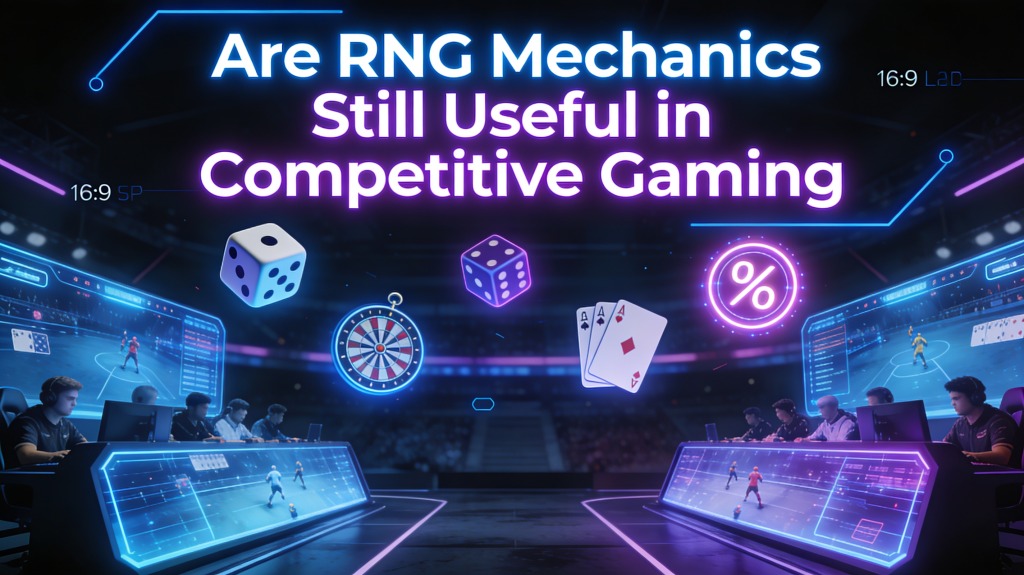
Is a championship title truly earned if the winning moment came down to a critical hit percentage or a lucky spawn location? This question has plagued competitive gaming since the earliest days of digital sports, but the conversation has reached a fever pitch in 2026. As prize pools swell and careers hang in the balance, the tension between pure skill expression and random number generation (RNG) has become the industry’s most divisive topic. While casual audiences often crave the unpredictability that randomness brings, professional competitors are increasingly demanding consistency to ensure that the better player actually wins.
Analyzing The Impact Of Luck On Tournament Results
When a top-tier team is eliminated from a major tournament due to an unlucky circle shift in a Battle Royale or a bad draw in a card game, the immediate reaction is often outrage. Critics argue that excessive variance undermines the legitimacy of the results, reducing complex strategic showdowns to glorified games of chance. This perspective holds that in an ideal competitive environment, variables should be minimized so that mechanical precision and tactical decision-making are the sole determinants of victory. When luck plays too large a role, it becomes difficult to distinguish between a fluke victory and a genuine display of mastery.
However, a counter-argument suggests that managing luck is, in itself, a skill. Proponents of RNG mechanics argue that the ability to adapt to unforeseen circumstances is what separates good players from great ones. Rather than hoping for a perfect scenario, elite competitors calculate probabilities and mitigate risk. This analytical approach has led to a surge in data literacy among gamers. Much like enthusiasts who scrutinize platform fairness and payout structures at the online casinos featured in this guide, competitive players now study game engines and drop rates to understand the mathematical architecture of their chosen title. They treat the game code as a law of physics they must navigate, rather than a biased referee.
The impact on tournament standings is undeniable, often creating “Cinderella stories” where underdogs topple giants thanks to a fortunate sequence of events. While these moments generate viral clips and hype, they can distort rankings. If a consistent team loses early due to bad RNG, the entire bracket changes, potentially robbing viewers of a “best vs. best” grand final. Tournament organizers have tried to combat this by introducing longer series formats, such as best-of-seven matches or double-elimination brackets, which allow skill to shine through over a larger sample size despite the noise of randomness.
Professional Players Adapt Strategies To Mitigate Variance
For the athletes whose livelihoods depend on consistent performance, complaining about RNG is rarely a productive strategy. Instead, the meta-game in titles like Fortnite, Hearthstone, or even Dota 2 has evolved specifically to dampen the effects of bad luck. In Battle Royales, this often means prioritizing positioning and resource gathering early in the match to ensure survival regardless of where the safe zone shifts. It is a form of insurance policy; by over-preparing for the worst-case scenario, pros ensure that they are never left completely helpless by the game’s algorithm.
This shift in mindset has changed how teams practice. It is no longer enough to just have sharp aim or perfect timing; teams now run simulations of “disaster scenarios” where they are forced to play with suboptimal loot or terrible positioning. The goal is to raise their “floor” performance so that even on their unluckiest day, they can still scrape by with points. This resilience is now considered a core attribute of a Tier 1 team. We see this in how shot-callers communicate; the language has shifted from “we need this item” to “what is our play if we don’t get this item?”
Furthermore, players are becoming vocal about which types of RNG are acceptable. “Input randomness,” where the game state is random but known before a decision is made (like a card draw), is generally accepted because it tests decision-making. “Output randomness,” where the result of an action is random (like a weapon jamming or a damage spread), is universally reviled. By focusing their feedback on removing output randomness, professional bodies have successfully lobbied developers to standardize spray patterns and damage numbers, allowing them to control the variables that matter most.
Comparing Digital Loot Odds To Traditional Risk Models
The economics of in-game loot and critical strikes share a surprising amount of DNA with traditional risk assessment models. In 2026, the discussion has moved beyond simple complaints to a sophisticated understanding of probability curves. When a game designer implements a 1% critical hit chance, they aren’t just adding flavor; they are introducing a variance curve that can be mathematically modeled. Players who understand these “digital odds” can exploit them, playing aggressively when the math favors them and retreating when the probabilities tilt the other way.
This fascination with the underlying numbers has coincided with the massive financial growth of the sector. The stakes are higher than ever, with the global esports market reached approximately $2.89 billion in 2025, proving that despite the debates over integrity, the spectacle of uncertainty continues to draw massive investment and viewership. The audience seems to enjoy the tension that RNG provides, even if the competitors despise it. It creates a narrative tension similar to traditional sports, where a weird bounce of the ball can change history.
However, there is a fine line between excitement and frustration. If the “loot odds” feel too punitive, players disengage. It is a balancing act that developers must maintain. If the risk model is too chaotic, the game feels broken. If it is too static, it feels like a spreadsheet. The most successful esports titles of the last year have managed to hide the math behind flashy visuals, making the RNG feel like “fate” rather than a random number generator. This psychological framing is crucial for maintaining the suspension of disbelief required for fans to invest emotionally in the outcome.
Developers Respond With Patches To Balance Randomness
In response to the growing sophistication of the player base, developers have started implementing “pseudo-random distributions” (PRD) to smooth out the edges of pure luck. In a true random system, a 25% chance to bash an opponent could theoretically not happen for twenty hits in a row, or happen five times consecutively. PRD adjusts the odds dynamically: every time the effect doesn’t trigger, the chance increases for the next hit, and resets once it occurs. This ensures that the actual occurrence rate matches the stated percentage over a short period, preventing the extreme luck streaks that ruin competitive matches.
These subtle tweaks are essential for retaining the massive audiences that sustain the ecosystem. The appetite for high-level play remains voracious, evidenced by the fact that the League of Legends Finals reached a peak viewership of 6.7 million last year. Viewers want to see skill, but they also want the hype of the unexpected. By using PRD and other “bad luck protection” systems, developers can keep the excitement of randomness without letting it completely overshadow competitive merit.
Ultimately, the goal for 2026 and beyond is not to eliminate RNG, but to domesticate it. We are seeing a trend where competitive modes feature different settings than casual modes, stripping away the wildest elements of chance for the pros while leaving them in for the public. This bifurcation allows the game to be a fun, chaotic party for the masses while serving as a rigorous test of skill for the elite. As the industry matures, this compromise seems to be the only way to satisfy both the purists who demand fairness and the millions of fans who tune in hoping to see the impossible happen.
Last Updated: February 9, 2026