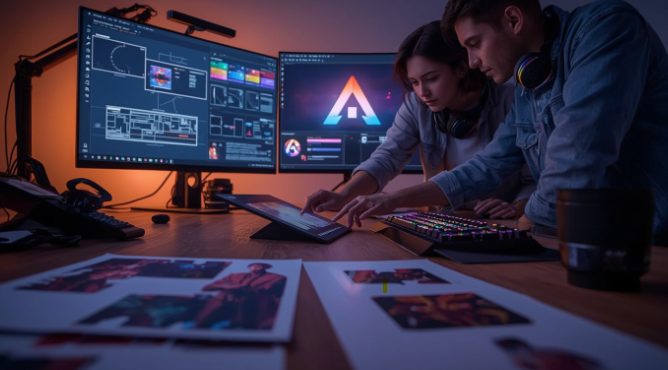
A logo is not a brand. Most companies still haven’t figured that out.
Walk into any gaming expo – PAX, Gamescom, take your pick – and you’ll notice something odd. The games themselves are stunning. Cinematic, immersive, technically jaw-dropping. Then you look at the booth design, the app store page, the website. And it’s… fine. Generic. Forgettable. The same sans-serif font everyone else is using, the same neon-on-black color palette that screamed “gamer aesthetic” circa 2014.
Here’s the uncomfortable truth: most gaming and tech companies treat branding as decoration. Something you slap on after the product is built. But the world’s top design agencies have known for decades that brand identity is infrastructure – not ornament. It shapes how users feel before they ever touch the product.
According to a Lucid Press report, consistent brand design can increase revenue by up to 23%. That number alone should end the argument. But let’s go deeper.
What separates a good brand from an iconic one
There’s a reason Riot Games looks like Riot Games, and not like every other studio. Or why Slack – a glorified chat tool, technically – became a $27 billion company partly on the strength of its design language. These aren’t accidents.
The agencies behind the world’s most recognized identities operate from a completely different philosophy. For them, branding and UX are inseparable. The visual system, the interaction patterns, the tone of voice – all of it runs on the same engine.
Firms consistently ranked among the top brand agencies globally treat digital products and brand identity as one continuous experience – not two separate departments arguing in Slack (ironically). The best among them, including those you can explore if you visit website, work across the full stack: from naming and positioning to UI systems and motion design.
That holistic approach is exactly what most gaming and tech brands are missing.
Three things top agencies do that product teams rarely think about
1. They start with positioning, not pixels.
Before anyone opens Figma, the best agencies ask: what does this brand mean? What feeling does it create? What does it stand for when the product isn’t in front of you? Positioning is the strategy underneath the design – and without it, even beautiful visuals feel hollow.
A brand strategy defines the competitive space the company wants to own. For a gaming studio, that might be the feeling of discovery. For a SaaS company, it might be radical simplicity. Without that north star, design decisions are just guesses.
2. They design for scale from day one.
Small studios and early-stage tech companies often make branding decisions that look fine at launch – and fall apart the moment they try to expand. An icon that works at 512px becomes a smear at 16px. A color palette that reads beautifully on desktop looks muddy in a mobile notification.
Top agencies build what are called design systems – modular, scalable frameworks that maintain consistency across every touchpoint. Think of it as a rules engine for your brand. According to research from McKinsey, companies with strong design practices outperform industry benchmarks by up to 32% in revenue growth. Coincidence? Hardly.
3. They treat emotion as a design material.
This is the part most tech teams find hardest to quantify – but it’s arguably the most important. Behavioral science is now a standard tool in the toolkit of leading UX design agencies. The way a loading animation behaves. The micro-copy on an error message. The haptic feedback when you complete a level. These details accumulate into a feeling that users may never consciously notice – but absolutely feel.
“Design is not just what it looks like and feels like,” Steve Jobs once said. “Design is how it works.” Agencies that understand this don’t just make things look good. They make things feel trustworthy, exciting, or human – whatever the brand requires.
Why this matters specifically for gaming companies
Gaming brands have a unique challenge. Their audiences are sophisticated, skeptical of corporate polish, and allergic to anything that feels fake. Slick branding that doesn’t match the product experience gets roasted on Reddit within 48 hours. (We’ve all seen it happen.)
But that same audience – when the brand does resonate – becomes the most loyal, vocal, and marketing-efficient fanbase imaginable. The difference between Hades building a cult following and a technically similar game disappearing into the void is rarely the game itself. It’s often the digital identity: the visual language, the community tone, the consistency of experience from Steam page to Discord server to patch notes.
Here’s a useful checklist for any gaming or tech brand doing a self-audit:
- Does your visual identity work across all screen sizes and contexts?
- Does your brand voice sound the same in a tweet, a press release, and an in-game notification?
- Could someone identify your brand from a single design element, without the logo?
- Are your UI patterns consistent with your brand personality – or do they contradict it?
- Does your website communicate your value in under five seconds?
If more than two of those answers are “not really” – there’s work to do.
What the smartest tech companies already figured out
The companies that have cracked this – Google, Slack, Figma, Notion – didn’t do it by accident or by having an unusually talented in-house designer. They invested early and deliberately in brand identity systems built by people who think about these problems full-time.
Clay, a San Francisco-based UX and branding agency, is a strong example of what this kind of investment looks like in practice. Their clients include Google, Slack, Snapchat, and Fiverr – companies that understand brand equity as a business asset. Their approach of treating digital product design and brand identity as one unified system is increasingly becoming the standard among ambitious tech companies.
The takeaway isn’t “hire an expensive agency and everything will be fine.” It’s more nuanced than that. It’s that the philosophy top agencies bring – strategy before aesthetics, systems over one-off designs, emotion as intentional output – is available to any team willing to think that way.
Final thoughts
Branding isn’t a tax on creativity. Done well, it is the creative act – the one that determines whether everything else gets seen, remembered, and chosen. Gaming and tech companies that treat it as optional are leaving something real on the table. Not just revenue, though that too. They’re leaving connection.
The studios and startups that will define the next decade of the industry aren’t just building better products. They’re building better worlds – and they know that every pixel, every word, every interaction is part of that world. The best brand design agencies figured that out a long time ago. The question is how long it takes everyone else to catch up.
Last Updated: May 25, 2026