You may spot a streak of orange or green in a moissanite ring under a spotlight. But, if you place that exact same ring near a window on a cloudy day you might have trouble finding the flash. It’s worthwhile to see the ring in both lights before you purchase a moissanite ring. Like diamonds, moissanite can also split white light into colours. Even so, you do not get a rainbow each time you glance at your hand.
What jewelers mean by “fire”
“Fire,” in terms of jewelry, refers to the flash of color you see when light separates into its individual wavelengths. Diamonds have fire too. When you tilt a round brilliant, you might see a red flash disappear while a white facet lights up right next to it. These are two different effects that people describe as sparkle.
Gemological Institute of America (GIA) measurements of synthetic moissanite indicate it has a dispersion of 0.104 compared to 0.044 for diamond. This disparity explains why the flash is sometimes so prominent. However, it does not mean a completed ring will appear twice as bright. Cut and angle of entry of light can play a significant role.
Begin with the cut
Browsing Cullen Jewellery moissanite engagement rings is a handy way to compare cuts side by side, and this selection shows how an oval or a round brilliant handles all that extra light on an actual hand.
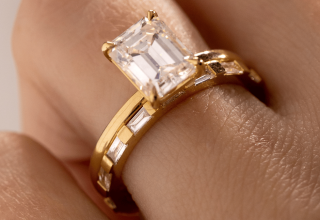
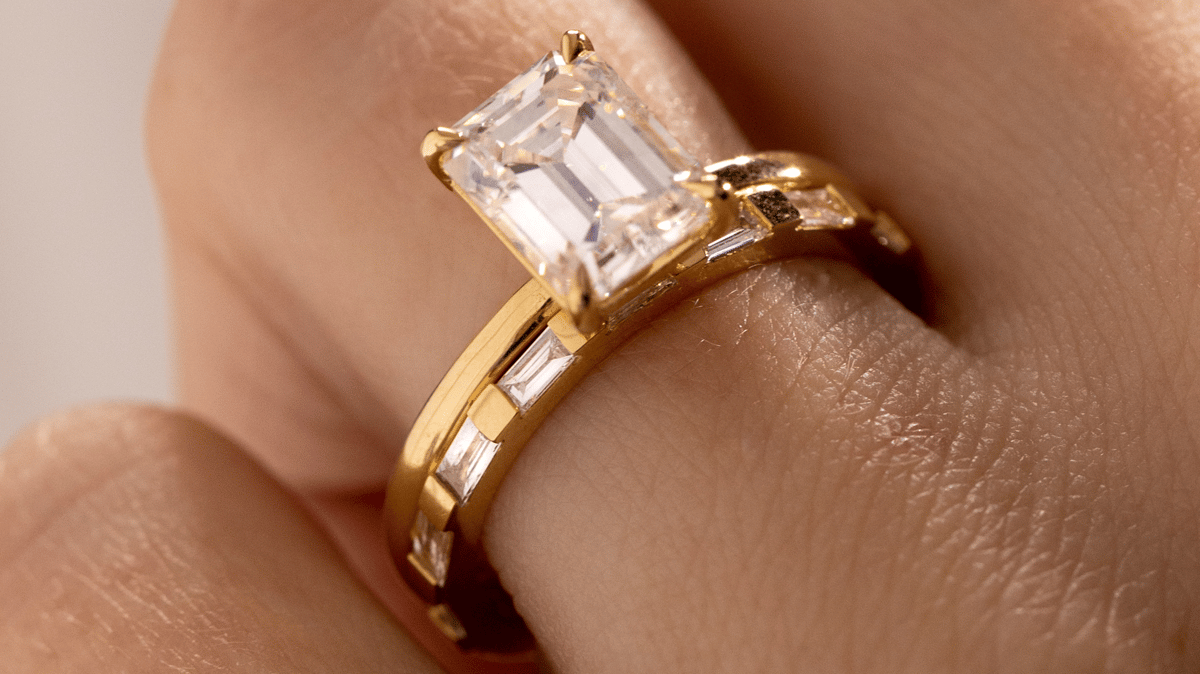
Looking at the rectangular stone shown in the photo above, follow one of its long facets from corner-to-corner and you’ll understand why a step-cut produces large sections of light. A round brilliant creates small areas that flash as you move your hand. If you prefer having a large center stone but find flashing distracting, consider an emerald cut prior to deciding on a smaller stone. Our guide to engagement ring styles provides multiple outline examples side-by-side.
Away from the spotlight
When comparing two rings, put them on neighboring fingers and then walk back a few feet from the counter. Now, examine them with your arm in a relaxed position. Next, slowly turn your wrist in the light coming through a window. Which one grabs your attention when you’re not directly holding it six inches from your face?
Light coming from a single ceiling spotlight can produce color, even in low lighting conditions inside restaurants. Bright rooms with soft light can reduce the appearance of color in the same stone. Therefore, neither “indoor” nor “outdoor” is specifically useful alone as a description. GIA photographs showing a diamond under varying lighting conditions provide a clear example of how drastically different they can be. If purchasing online, request that they include clips taken in diffused daylight along with the standard turntable shot.
What the price and hardness tell you
The moissanite sold in engagement rings is generally lab-grown silicon carbide. A diamond is carbon, whether it came out of the ground or a laboratory. For a fair price comparison, ask for quotes on stones of similar dimensions in the same setting and metal.
Moissanite has a hardness rating of approximately 9.25 on the Mohs scale, with diamond rated at 10. The number indicates resistance to scratching, and none of it addresses whether the gold claws on your new engagement ring will hold up to being pulled by a barbell while lifting weights.
The moment that settles it may come after you leave the shop. If the image that remains with you was that green flash that occurred when reaching for your jacket, moissanite’s ability to create fire is certainly enough justification to select it.
Last Updated: November 23, 2026