
Ten years ago, a major European city kicked coffee capsules out of its state-run buildings and called them a waste of resources. What sounded like a fussy local rule at the time now looks like the opening move in a much bigger argument about how offices trade convenience for garbage.
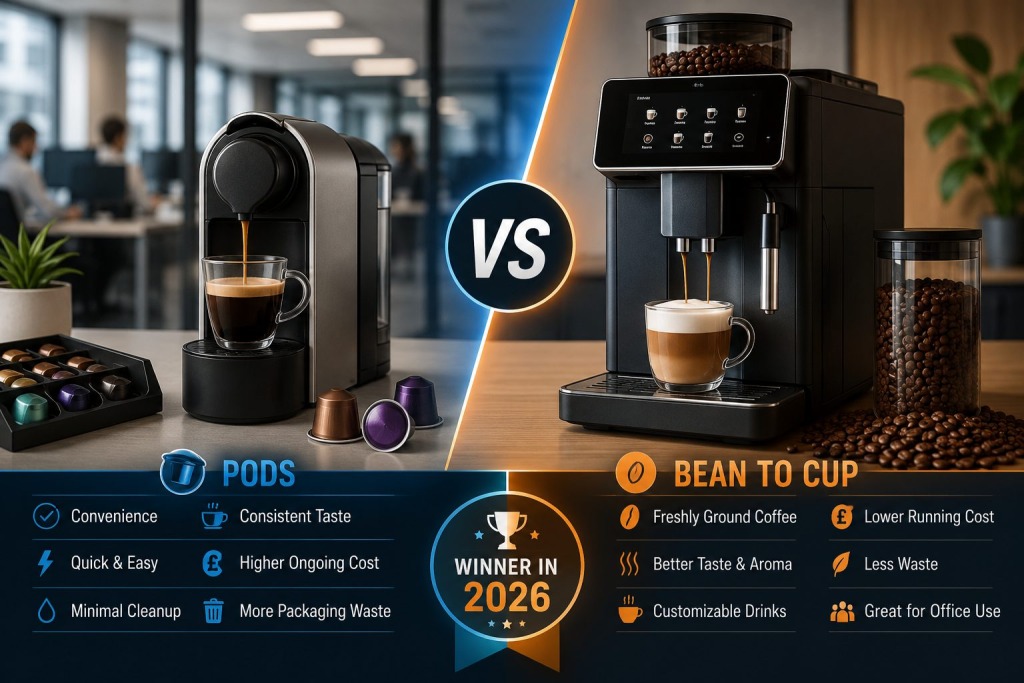
In 2026, the office coffee question has narrowed to two contenders: pod machines that promise speed, and bean-to-cup machines that grind fresh for every drink. Both work fine. They just win on different terms.
The Case for Pods Is Convenience
Pod machines earned their spot in offices for one reason: they remove friction. Drop in a capsule, hit a button, walk away with a drink. No grinder to clean, no hopper to refill, no fifteen-minute onboarding for the new starter.
For a small team drinking a handful of cups a day, that simplicity is hard to argue with. The machine is cheap to buy. Servicing is minimal. If something breaks, you swap the unit instead of booking a technician.
The catch is what happens after the button push. Every drink produces a small parcel of mixed plastic, aluminum, and wet grounds, and that parcel has to go somewhere.
The Case Against Pods Is Everything Downstream
The waste math turns ugly quickly. Roughly 56 billion pods end up in landfills each year, about 95% of everything produced. And because the packaging mixes materials, most municipal recycling streams can’t handle it without extra sorting.
Then there’s the per-cup cost. Capsules are priced for supermarket convenience, not office volume. A team getting through fifty drinks a day is paying for premium packaging as much as it’s paying for coffee. Run that across a year and the numbers stop looking clever.
Pods also flatten the drink. You get what the manufacturer decided you should get. Ask for a longer black, a stronger espresso, or oat milk instead of dairy, and the machine shrugs.
Bean to Cup Wins on Volume and Quality
A bean-to-cup machine grinds whole beans on demand and brews straight into the cup. That’s the whole trick, and it’s why office buyers keep drifting toward them once cup counts climb. Fresh grind, adjustable strength, real milk texturing, and one waste stream: spent grounds, which compost.
The commercial market shows where the money is moving. Offices and hospitality are doing most of the heavy lifting.
The machine costs more up front. It usually needs a plumbed water line and a routine clean. But once you’re past a certain cup count, it undercuts pods on both cost and carbon per drink.
Where Each Setup Actually Wins
- Small teams, low volume. Under about 20 cups a day, a pod machine is often the sensible call. The capital outlay is low and the waste, while real, is a smaller absolute number.
- Growing offices, mixed preferences. Once you have people ordering flat whites, long blacks, and dairy alternatives in the same ten-minute stretch, bean-to-cup pays back fast. One machine covers the whole menu.
- High-traffic sites. Anything above 60 cups a day tips the economics for good. Rental packages with maintenance bundled in spread the cost and take servicing off your plate, which is how providers of coffee machines in London like EatJar, for example, structure their subscriptions.
- Sustainability-led workplaces. If your office reports on waste or has a serious ESG commitment, pods are a hard sell. Grounds compost. Foil-and-plastic capsules don’t, at least not without a lot of effort.
The Deciding Question Isn’t the Machine
It’s the demand pattern. Count the daily cups honestly, factor in the drinks people want rather than the ones they’ll settle for, and add the disposal reality of whatever contract you’re about to sign. Pods look cheap on the invoice and expensive everywhere else. Bean-to-cup looks expensive on the invoice and gets cheaper the more it runs.
Pick the setup that matches how your office drinks coffee, not the one that matches the smallest sticker price.
Last Updated: July 24, 2026