
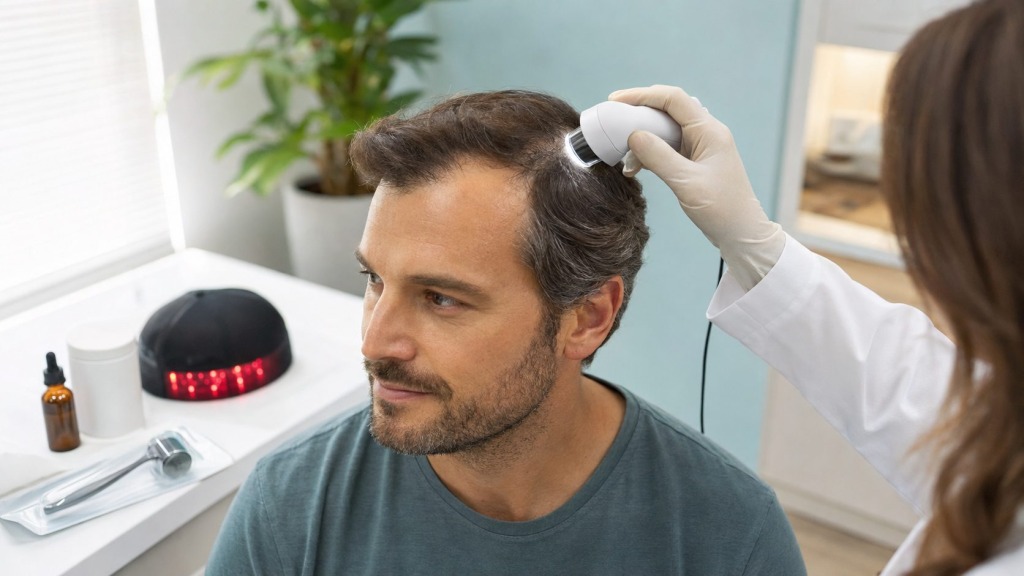
The best hair transplant alternatives for men are treatments that help preserve active follicles, improve scalp conditions, and support natural regrowth before hair loss becomes advanced. Depending on the stage of thinning, options may include minoxidil, PRP, microneedling, laser therapy, scalp-focused care, and stem cell hair treatments like CALECIM® Professional.
Non-surgical approaches tend to work best when follicles are still miniaturized or sluggish rather than permanently inactive. That is why early intervention often matters more than many people realize.
According to the American Academy of Dermatology, male pattern hair loss can begin in the late teens or twenties, usually progresses slowly, and has treatment options. The organization also notes that by age 50, more than half of white men show visible signs of male pattern hair loss.
The best hair transplant alternatives for men support active follicles, improve scalp conditions, and help preserve density without surgery
The most effective hair transplant alternatives focus on supporting living follicles instead of simply masking thinning hair. Treatments are generally more successful when they help maintain follicle activity, reduce shedding triggers, and improve scalp health over time.
Many men assume surgery is the only meaningful solution once thinning begins. In reality, several non-surgical approaches may help slow progression or improve visible density before a transplant becomes necessary.
The goal is not always dramatic regrowth. In many cases, preserving existing density and improving hair quality can create a fuller appearance while delaying more invasive procedures.
Common non-surgical goals include:
- slowing follicle miniaturization
- improving scalp environment
- reducing inflammation-related shedding
- supporting thicker-looking strands
- maintaining active follicles longer
Natural regrowth is most realistic when hair follicles are thinning, sluggish, or dormant rather than permanently inactive
Natural regrowth is most achievable when follicles still retain some biological activity. Once follicles become severely miniaturized or inactive for long periods, regrowth becomes more difficult.
NCBI Bookshelf explains that follicle miniaturization is the histological hallmark of androgenetic alopecia. This means hair follicles gradually shrink over time, producing finer and shorter hairs.
Why early thinning responds better than advanced bald areas
Early thinning usually responds better because follicles are still present and partially functional. The earlier support begins, the more likely follicles are to respond to stimulation and scalp-focused treatments.
Signs that follicles may still respond include:
- widening part or thinning crown
- finer strands instead of bare scalp
- increased shedding with visible hair still present
- slower regrowth after haircuts
Advanced bald areas with smooth, shiny scalp are often harder to improve without surgery because follicle activity may already be significantly reduced.
Why scalp inflammation can make shedding and thinning worse
Scalp inflammation may contribute to a less supportive environment for healthy hair cycling. Chronic irritation, buildup, oxidative stress, and inflammatory signaling can worsen shedding in some people.
This is one reason many newer hair-support systems focus on scalp balance alongside follicle stimulation rather than targeting hair strands alone.
The main non-surgical alternatives include Minoxidil, PRP, microneedling, laser therapy, scalp care, and stem cell hair treatments
Hair transplant alternatives work through different mechanisms. Some stimulate growth signaling directly, while others mainly improve scalp conditions or create temporary cosmetic fullness.
Which options stimulate growth signals
The most common growth-focused options include:
| Treatment | Main Goal | Typical Best Use |
| Minoxidil | Supports follicle stimulation | Early-to-moderate thinning |
| PRP | Uses growth-factor-rich plasma | Professional treatment plans |
| Microneedling | Creates controlled micro-injury response | Combination therapy |
| Low-level laser therapy | Supports follicle activity | Long-term maintenance |
| Stem cell hair treatments | Support signaling environment | Early thinning and density support |
Which options mainly support scalp health or cosmetic thickness
Some approaches improve how hair looks without necessarily changing follicle biology significantly.
These may include:
- volumizing shampoos
- scalp exfoliation
- camouflage fibers
- thickening sprays
- anti-inflammatory scalp care
They can still be useful, especially alongside treatments aimed at follicle support.
Dermatology and Therapy reviewed microneedling studies for hair loss disorders and described it as a minimally invasive treatment approach often used in combination with other therapies.
PubMed also indexes research evaluating low-level laser therapy as a possible treatment option for androgenetic alopecia.
A comparison table can help men choose based on hair loss stage, timeline, side effects, cost, and convenience
The best treatment depends on how advanced the thinning is, whether medication is acceptable, and how much maintenance someone is willing to commit to.
Best options for early thinning
Men with early thinning often respond best to treatments that support follicle activity before major density loss occurs.
| Situation | Often Most Relevant |
| Mild crown thinning | Minoxidil, stem cell hair systems, laser therapy |
| Increased shedding | Scalp-focused support, PRP, microneedling, stem cell treatments |
| Medication avoidance | Laser therapy, microneedling, stem cell hair treatments |
| Rapid progression | Dermatologist evaluation, prescription options |
Best options for men avoiding medication or surgery
Some men prefer non-drug approaches because of lifestyle preference or concerns about long-term medication use.
In these situations, options like microneedling, low-level laser therapy, PRP, and stem cell hair treatments may be explored before considering surgery.
That does not mean they are guaranteed to work for everyone. Results vary depending on follicle activity, consistency, genetics, and scalp health.
Stem cell hair treatments may be a strong option when the goal is follicle support, density improvement, and natural-looking regrowth
Stem cell treatments for hair, such as CALECIM® Professional, are designed to support the signaling environment around follicles rather than simply coating the hair shaft. They may be most useful when follicles are still present but functioning less efficiently.
These treatments are increasingly discussed because they focus on regenerative signaling instead of only temporary cosmetic thickening.
How growth factors, cytokines, proteins, and exosomes support follicle signaling
Growth factors, cytokines, proteins, and exosomes are involved in cell communication and tissue repair signaling throughout the body.
Some regenerative hair systems aim to support:
- follicle signaling
- scalp recovery
- inflammation balance
- hair cycling support
- dermal papilla activity
Why reducing signs of scalp inflammation matters for long-term density
Persistent scalp inflammation may contribute to weaker follicle conditions over time. Supporting scalp balance may therefore help create a healthier environment for existing follicles.
CALECIM® Professional testing resulted in a 24% increase in follicle cell proliferation and a 30-fold decrease in inflammation markers during in vitro testing.
CALECIM® Professional Hair Serum fits men who want a clinic-inspired at-home hair treatment before considering a transplant
CALECIM® Professional Hair Serum is designed for men who want an at-home hair treatment focused on follicle support, scalp balance, and density maintenance before moving toward surgical restoration.
The system combines hair serum containing PTT-6® with a derma stamper intended to support product absorption and scalp preparation.
How PTT-6® supports follicle function and scalp balance
PTT-6® contains over 3,000 proteins, including growth factors, cytokines, and exosomes involved in regenerative signaling.
The company also reports that 12-week test subject data showed:
- 16% increase in hair width
- 14% increase in hair count
- 15% increase in active follicles per square centimeter
Why the treatment and maintenance phases matter
Hair growth is gradual because follicles cycle through different biological phases over time. Consistency often matters more than intensity.
According to CALECIM® Professional, the treatment is applied twice weekly during the treatment phase and once weekly during maintenance.
This type of schedule is designed to support ongoing follicle and scalp maintenance rather than create instant cosmetic results.
Best for
CALECIM® Professional Hair Serum may be best for:
- men with early-to-moderate thinning
- men exploring medication-free support options
- users wanting an at-home routine
- men interested in regenerative-style hair support
Not best for
It may not be the best standalone option for:
- advanced baldness with inactive follicles
- sudden unexplained hair loss
- patchy autoimmune-related shedding
- people expecting immediate regrowth
Men should consider professional evaluation when hair loss is sudden, severe, patchy, or no longer responding to at-home care
When non-surgical options may still support existing hair
Even if surgery becomes appropriate later, non-surgical support may still help preserve surrounding hair and improve scalp conditions.
This is one reason many clinics combine surgical and non-surgical strategies rather than relying on only one approach.
The right choice depends on whether you want early intervention, medication-free support, professional treatment, or surgical restoration
There is no single best hair transplant alternative for every man. The right option depends on hair loss stage, scalp condition, tolerance for medication, budget, lifestyle, and long-term goals.
Men with early thinning often have the widest range of non-surgical choices because follicles are still more responsive at that stage.
For many men, the most realistic approach is not choosing between “natural regrowth” and “transplant.” Instead, it is combining preservation, scalp support, consistency, and realistic expectations before hair loss becomes advanced.
FAQ
What is the best alternative to a hair transplant for men?
The best alternative depends on the stage of hair loss and your goals. Common non-surgical options include minoxidil, PRP, microneedling, laser therapy, and stem cell hair treatments designed to support follicle activity.
Can men regrow hair naturally without surgery?
Some men may improve density or reduce thinning without surgery if follicles remain active. Earlier-stage thinning usually responds better than advanced baldness.
Do stem cell hair treatments work for male hair loss?
Stem cell hair treatments may support follicle signaling and scalp balance, particularly in early thinning stages. Results vary depending on follicle condition and consistency.
Is CALECIM® Professional Hair Serum a no-side-effect hair treatment?
CALECIM® Professional Hair Serum is positioned as a non-drug, at-home treatment system. According to the brand, no adverse effects were noticed.
How long does it take to see results from an at-home hair treatment?
Hair growth cycles are slow, so visible changes often take several weeks or months. According to CALECIM® Professional, its treatment phase is designed around a 6-week cycle.
Is PRP better than stem cell hair treatment?
Not necessarily. PRP and stem cell hair treatments work differently, and the best choice depends on goals, budget, treatment preference, and hair loss stage.
Can microneedling improve hair growth?
Microneedling may support hair treatment outcomes, especially when combined with other therapies. It is commonly used as a supportive treatment rather than a guaranteed standalone solution.
When is a hair transplant still necessary?
A transplant may become more realistic when bald areas are advanced, follicles are inactive, or density can no longer be improved adequately with non-surgical approaches.
Conclusion
The best hair transplant alternatives for men are the ones that match the stage of hair loss, support existing follicles, and fit realistic long-term goals. Early thinning often responds better to non-surgical strategies because follicles are still active and more capable of responding to support.
For men looking for a clinic-inspired at-home hair treatment before considering surgery, CALECIM® Professional Hair Serum may offer a regenerative-focused option designed to support follicle function, scalp balance, and density maintenance over time.
The earlier hair loss is addressed, the more treatment options are typically available.
Last Updated: August 3, 2026