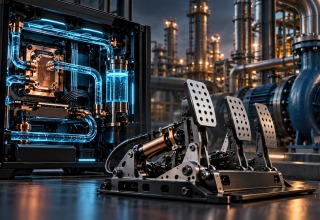
A water-cooled gaming PC, a hydraulic sim racing pedal and a refinery pump look like unrelated bits of kit. Yet each depends on getting fluid behavior right. The PC needs coolant moving through its blocks. The pedal needs a predictable pressure response. The refinery needs liquid delivered at the required flow and pressure, hour after hour.
The scale can be enormous. A 2005 US Department of Energy tip sheet put annual electricity use by pumps in US manufacturing at more than 142 terawatt-hours. That’s a historical estimate, rather than a current reading, but it gives some perspective on why engineers spend so much time on pumping efficiency.
For a home builder, the stakes are smaller. You still pay for poor choices through noise, disappointing temperatures or hardware that doesn’t feel right. Understanding the job before buying parts helps in all three cases.
High Flow or High Pressure: Pick the Wrong One and Nothing Works
Before selecting hardware, decide what the fluid needs to do. Flow rate tells you how much liquid moves in a given time. Pressure difference helps drive that movement against resistance. A refinery feed pump may need to move a large volume against substantial resistance. A PC loop is smaller, but its water blocks, radiator passages and fittings still restrict the coolant.
A hydraulic brake pedal is different again. It displaces a small amount of fluid to build pressure; it isn’t trying to keep coolant circulating.
For a pump, flow and pressure are linked by its performance curve. You don’t simply choose one and sacrifice the other. The operating point is where the pump’s curve meets the system’s resistance curve. A high maximum-flow figure measured with little restriction tells you very little about performance in a crowded cooling loop.
Work out the required flow and resistance first, then compare suitable pumps. The biggest number on the box won’t do that work for you.
Chase Laminar Flow or Live With Turbulence
Fluid can move in smooth layers, known as laminar flow, or with the mixing and fluctuations of turbulent flow. Between them is a transition region. Reynolds number helps describe which behavior to expect, taking account of fluid properties, speed and the dimensions of the passage.
That distinction matters when you’re moving heat. Mixing can bring cooler liquid toward a hot surface and improve heat transfer, although it also brings frictional losses. Turbulence isn’t automatically a sign of a bad design, nor does it necessarily mean a system will be audibly noisy.
Inside a CPU block, channel geometry has to balance heat transfer against restriction. In refinery piping, turbulent flow is common at practical operating rates. A brake circuit has a different priority: consistent pressure transmission with very little fluid movement. Treating all three as a contest to produce the smoothest possible flow misses what each system is doing.
Buy the Bigger Pump or Fix the Restriction
When temperatures disappoint, a stronger pump can look like the obvious purchase. Sometimes more pumping capacity helps. Before ordering, though, check for a kinked tube, a partly closed valve, a clogged block or an unnecessarily restrictive fitting.
Also separate the coolant side from the air side. Dense external radiator fins resist airflow; they don’t directly narrow the coolant passages. If the radiator isn’t getting enough air, changing the liquid pump may leave the main problem untouched.
Map the loop and look for the actual bottleneck. Extra pump speed can bring additional noise and power consumption without a worthwhile temperature improvement once flow is adequate.
Industrial pumps need the same attention to their inlet conditions. Cavitation can occur when local pressure falls low enough for vapor bubbles to form and then collapse. Engineers compare the net positive suction head available with the pump’s requirement and allow an appropriate margin. Reducing suction losses may help, but liquid temperature and the operating point matter too. A larger pump isn’t a universal cure.
Feel the Fluid or Fake It
A race car’s hydraulic brakes transmit pressure through fluid that is nearly incompressible. Pressing the pedal displaces fluid and drives the caliper pistons. The pedal’s feel also depends on leverage, component stiffness and the rest of the system. It isn’t primarily produced by compressing the liquid.
Sim pedals reproduce aspects of that response in several ways. A load cell measures force, while springs or elastomers provide resistance. A hydraulic design can use fluid pressure as part of its mechanism. Hydraulic damping and load-cell sensing can also appear in the same pedal set, so the labels aren’t mutually exclusive.
For the builder, adjustment range and consistency matter more than assuming one label guarantees realism. Consider how the pedal behaves as you apply and release pressure, whether your frame stays rigid, and how comfortably you can repeat an input.
Hydraulic hardware may involve extra maintenance, depending on its design. A well-set-up load-cell pedal can still be a serious piece of equipment. Neither choice guarantees faster laps.
Standards Save You Money or Cost You Everything
The least glamorous decision is compatibility. In petroleum, petrochemical and natural-gas applications, API 610 sets requirements for centrifugal pumps. Whether a particular installation needs that standard depends on its service conditions and project specification.
For projects that specify them, API 610 process pumps, like these from PumpWorks, provide a defined starting point for equipment selection. Engineers still need to check the actual duty, materials and installation requirements. A standards reference doesn’t replace that work.
PC and sim hardware involve more modest checks, but overlooking them is still expensive. Match fittings to the tubing dimensions, check coolant compatibility with the loop’s materials, and confirm that the pedals can mount securely to your frame.
Do those checks before the parts arrive. It’s much easier to change a shopping list than to drain a finished loop or rebuild a pedal deck.
Last Updated: September 25, 2026