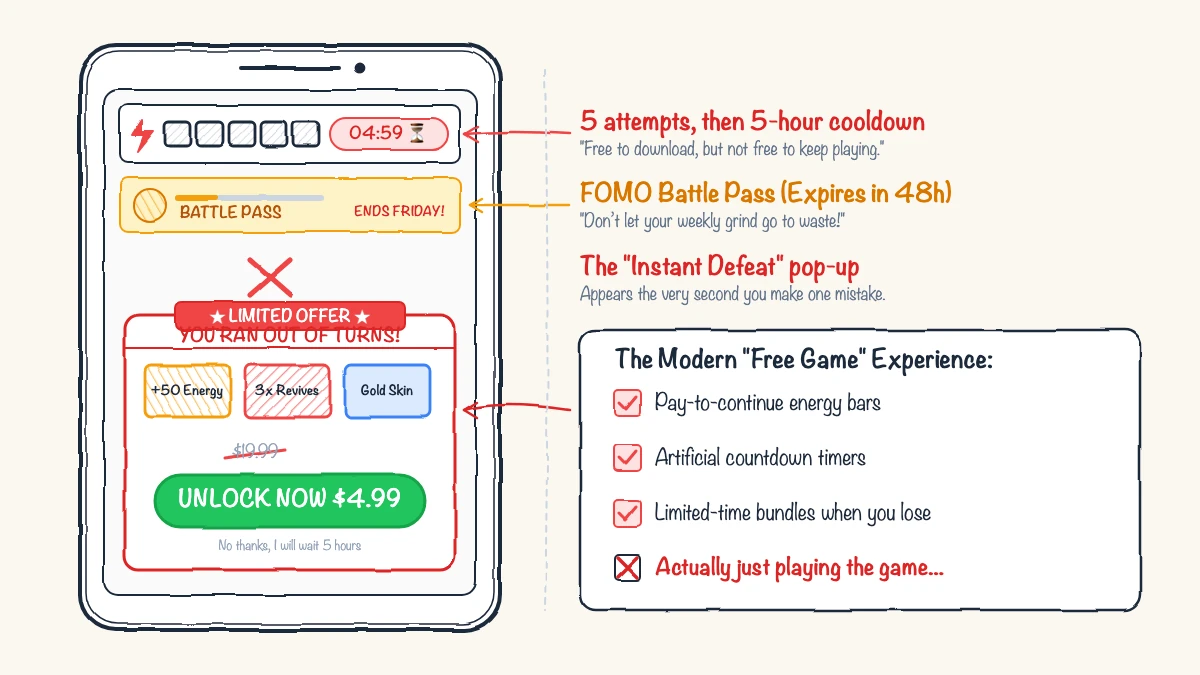
Type “free game” into an app store and you’ll find plenty to choose from. Many cost nothing to download. Then you start playing, and the requests begin: an energy bar runs out after five tries, your next upgrade sits behind a countdown, a battle pass ends on Friday, or a limited-time bundle appears just after you’ve lost.
Plenty of players have made peace with this. Still, when did “free” stop meaning you could just play?
Free to Start Is Not the Same as Free to Play
Getting a game onto your phone for nothing is one thing. Being able to enjoy it without paying is another. You only find out which deal you’ve been offered once you spend some time with it.
The ESRB’s guide to free-to-play games makes a useful distinction between buying optional outfits and buying something that speeds up progress or gives you an advantage. A shop icon doesn’t tell you much on its own. What matters is what happens when you leave it alone.
Many free-to-play games put small obstacles between you and the next attempt. You have a good run, lose a few times, and suddenly you’re waiting. Paying starts to look easier than sitting through another timer. Developers need income, of course. But there’s a point where you’re thinking more about the wait than the game.
Purchase design can also cause problems beyond irritation. In 2023, the FTC finalized a $245 million order against Epic Games to settle allegations involving unwanted purchases and unauthorized charges. It’s a reason to pay attention to how a game asks for money, as well as how much it asks for.
What the Old Browser Portals Got Right
If you were online in the early 2000s, you probably remember clicking a thumbnail, waiting for a game to load, and getting on with it. Many games needed no account. There was no season to finish or daily streak to protect. When you lost, you tried again.
Those games could be small and rough around the edges. There were often ads around them, too. But you could usually choose how long to play without an energy meter making the decision.
CriticalHit’s 2011 look at browser-based games captures some of that variety, from firefighting challenges to physics puzzles. Small games already had plenty of ideas.
That sort of experience hasn’t disappeared. It’s just easy to overlook when much bigger releases are fighting for your attention.
A Quick Test for a Genuinely Free Game
Four questions can help you work out what a game will ask of you:
Can you start in under a minute? A launcher, an account form and an email check all take time before you’ve even found out whether you like playing. That doesn’t make a game bad, but it does make a quick session less convenient.
Does a timer stop you from playing? Waiting for lives to refill may cost no money, but it still puts a limit on when you can have another go.
Does skill decide the outcome? It’s encouraging when a difficult level gets easier because you’ve learned its timing. It’s less satisfying when the obvious solution is to buy more moves.
Is the ad trade optional and honest? Ads help cover the cost of free games. Check what happens when you decline a reward video. Can you still carry on with a worthwhile game?
These questions won’t tell you everything. They will tell you more about the experience than the download price alone.
Where Browser Games Fit Back In
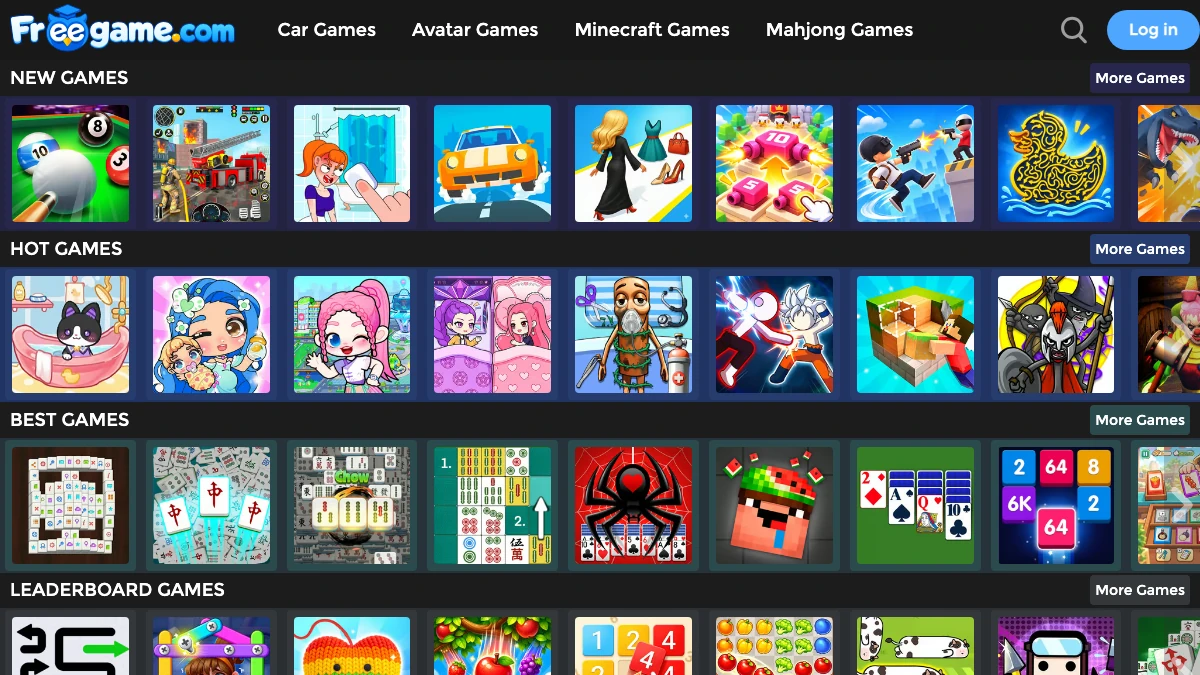
Browser games are an easy place to look for a short session. FreeGame.Com says its games run in the browser without downloads or required sign-ups. Its catalogue includes racing, puzzle and action categories, and its language selector lists ten options. You can browse for something that catches your eye, though individual games can differ.
It is not a perfect world. Some games offer short optional ads in exchange for bonus coins or a revive, which is the same trade that keeps free game running. The difference is that you can say no and carry on.
Free Does Not Mean Shallow
A game doesn’t need a payment screen to make you work. A driving game can demand that you start a drift at exactly the right moment. A drag racer can punish a late gear change. A physics puzzle can leave you staring at the same level until you finally see what you’ve missed.
That’s a satisfying reason to try again. You’re learning something about the game each time, and the next attempt is there when you want it.
The Next Time You Search
Next time you want something to play for a few spare minutes, try those four questions. Pay attention to what happens after the first loss, when an ad appears, or when the shop opens. That’s where you’ll get a better idea of what “free” means for the game in front of you.
Last Updated: November 11, 2026