A wallet connection can replace the usual passport upload on some crypto perpetual exchanges. It does not remove trading restrictions, checks on funds or the risk of losing your deposit. EVEDEX, Hyperliquid, dYdX, GMX and Aster offer different versions of wallet-based trading, and the details matter more than the no-KYC label.
EVEDEX’s getting-started guide lists a minimum deposit of 6 USDT. That is an entry requirement, not a sensible trading budget or a limit on losses. Across the five platforms, fees depend on the product, leverage changes by market, and collateral may be committed to smart contracts or a trading account.
This comparison checks the platforms’ published information as of 24 September 2026. It is an explanation of their access models, not a recommendation to trade. The FCA’s ban on selling cryptoasset derivatives to UK retail clients remains in place; wallet access does not override that restriction.
Key takeaways
- No-KYC trading usually describes access without conventional identity-document onboarding. It does not promise anonymity, unrestricted access or exemption from tax and sanctions rules.
- EVEDEX says it uses blockchain analysis for AML screening. Its documentation also contains differences on network details and leverage, which should be checked against the current trading interface.
- EVEDEX and Hyperliquid publish base perpetual fees of 0.015% maker and 0.045% taker. dYdX’s documented entry tier is 0.01% and 0.05%. Discounts and special markets can change the bill.
- Aster’s general crypto perpetual schedule lists 0% maker and 0.04% taker. Its separate 1001x product has different charges. GMX uses position fees rather than a maker/taker split.
- High leverage leaves little room for a price move against you. Maintenance margin, funding and fees can trigger liquidation before the simple leverage calculation suggests.
The five platforms at a glance
| Platform | Trading model | Published fees | Leverage and margin |
|---|---|---|---|
| EVEDEX | Off-chain matching with blockchain settlement; Arbitrum-based architecture | 0.015% maker / 0.045% taker before cashback | Cross margin; published leverage figures differ, so check the live contract |
| Hyperliquid | On-chain order book on its own L1 | Base perpetual tier: 0.015% maker / 0.045% taker | Up to 40x for BTC in the published margin table; lower limits elsewhere; cross and isolated modes |
| dYdX | Validator-maintained order books and settlement on dYdX Chain | Documented entry tier: 0.01% maker / 0.05% taker | Market-specific leverage and margin parameters; check the selected market |
| GMX | Oracle pricing against liquidity pools | Standard position fee: 0.04% or 0.06%; other charges and market exceptions apply | Up to 100x in supported markets; collateral allocated to positions |
| Aster | Order-book perpetuals plus separate 1001x and Shield products | General crypto perpetuals: 0% maker / 0.04% taker; separate schedules for other products | Up to 1001x on selected markets in the dedicated product; margin rules depend on the product |
Sources: the platforms’ official fee, margin and product documentation, checked 24 September 2026. These are published reference figures, not execution quotes. Funding, network costs, price impact and account discounts are excluded.
No KYC does not mean no compliance
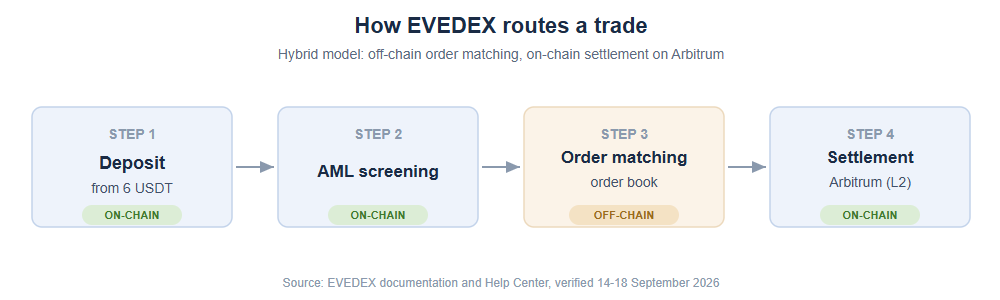
EVEDEX describes itself as a hybrid exchange. It combines an off-chain order book with blockchain settlement, placing it in the broad arbitrum dex category. Its Help Center says traditional KYC is not required for trading features and describes AML screening using on-chain behaviour analysis and activity monitoring.
That distinction is useful. A platform can analyse a wallet’s transaction history without asking its owner to upload a passport. Screening is still a check, and a public blockchain is not anonymous just because an account has no name attached.
Wallet access is also separate from eligibility. Read the restrictions for the exact platform, interface and product you intend to use. A card purchase, fiat provider or other third-party service may have its own identity checks. Aster also supports email-based access, while EVEDEX’s onboarding guide describes email and other sign-in options alongside external wallets.
Where a trade is matched and settled
EVEDEX’s broad design is clear: the matcher operates off-chain, while blockchain records support settlement. Its public documentation is less consistent about the network. Some pages describe Arbitrum L2; its onboarding guide refers to Eventum, and other documentation describes an Arbitrum-based L3. Those descriptions should not be treated as interchangeable. Confirm the actual deposit network and deployed contracts before transferring funds.
Hyperliquid uses its own Layer 1 and on-chain order book. dYdX also runs on a purpose-built chain, but its short-term orders sit in node memory until matched. Validators include matches in blocks. Calling both systems simply “fully on-chain order books” hides a useful difference in how orders are handled.
GMX prices positions using oracle data and liquidity pools. It does not need a matching order on the other side of an order book, but price impact, oracle spreads, pool capacity and execution rules still matter. Large orders are not automatically free of slippage or execution costs.
Nor does a wallet login mean trading collateral remains freely spendable in your wallet. Read how deposits, contract permissions, withdrawals and liquidations work. Smart-contract failures, bridge problems and service interruptions remain possible.
Fees and leverage behind the headline numbers
The maker/taker comparison is useful only when it covers the same type of trade. EVEDEX’s standard taker rate of 0.045% matches Hyperliquid’s base perpetual tier. dYdX documents 0.05% at its entry tier. Aster lists 0.04% for general crypto perpetuals, with different rates for other groups and products.
A 0.045% fee on a $10,000 position is $4.50. Opening and closing as a taker would cost about $9 if the position value stayed the same, before funding or other charges. The fee applies to the position value, not just the margin you deposited.
EVEDEX offers cashback linked to activity and subscription arrangements. Check the current reward rules before subtracting cashback from your expected costs. Hyperliquid and dYdX also have volume-based tiers and other adjustments.
Aster’s 1001x headline belongs to a separate product. Its documentation describes different opening and closing charges, including a dynamic closing fee for certain very high leverage positions. Pairing that leverage figure with the ordinary perpetual maker/taker schedule would give a misleading comparison.
EVEDEX’s own pages give differing leverage figures. Its contract-specification page lists 100x for BTC and ETH and 75x for SOL, while some marketing material advertises higher limits. This comparison therefore does not treat 200x as a verified universal ceiling. On dYdX, the cited market-selection guide explains market-specific margin parameters; it does not establish a platform-wide 20x maximum.
The basic risk arithmetic is unforgiving. With 100x exposure, a 1% adverse price move equals the starting margin before costs; at 200x, it takes only 0.5%. Actual liquidation can happen sooner because maintenance margin must remain in the account. Cross margin also ties the outcome to other positions and available collateral.
ESMA’s 2018 analysis found that 74–89% of retail CFD accounts typically lost money. That was research on CFDs, not a measured loss rate for these five perpetual exchanges. It is relevant background on leveraged trading, but it should not be presented as platform-specific evidence.
Where EVEDEX falls short
The cross-margin documentation says the whole futures account supports open positions and describes isolated margin as a planned addition. A losing trade can therefore consume collateral that also supports other trades. Someone who wants to ring-fence margin for each position needs to check whether the required mode is actually available.
Its standard taker fee also exceeds Aster’s published general-crypto rate, before discounts and other costs. More fundamentally, inconsistent public specifications make due diligence harder. A trader needs a clear answer on the contract, network, withdrawal route and margin rules before a fee comparison becomes useful.
Which platform fits which trading model
Hyperliquid and dYdX offer order-book trading on dedicated chains. GMX takes a pool-based approach. Aster has several products with substantially different pricing and risk rules. EVEDEX combines off-chain matching, blockchain settlement and a cross-margin account with crypto and other perpetual markets.
There is no reliable winner from a fee table alone. Order-book depth changes by market and time, and maximum leverage says little about execution quality. Compare the actual contract, total round-trip cost, margin treatment and withdrawal process. If access is restricted where you live, a wallet connection does not make the service available to you.
Written by Erekle Kevlishvili
Last Updated: September 24, 2026