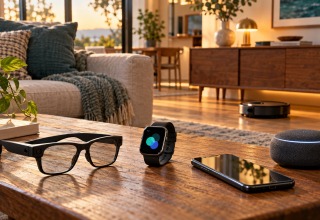
For generations, people imagined a future full of flying cars, robots and machines that can accomplish nearly anything. What tends to stay with us are the changes that come with little excitement. We start to use something because it saves a couple of minutes. A year goes by and we realize we had no idea how to manage without it.
The smartphone changed communication. Streaming changed the way we enjoy entertainment. Cloud-based computing allowed more flexibility to work from anywhere. Today, a new collection of technologies are moving toward our daily routines, from finding answers while cooking to vacuuming the floors while you’re away.
These include artificial intelligence, wearable devices, robotics, connected health technology, and smart homes. While some are useful now, others have a significant gap between demonstrating what they can do and being capable of performing those functions at home.
Below are five technologies changing daily life, with a look at what they can deliver now and what still needs work.
AI Assistants Are Becoming Parts of Everyday Life
In the early days of computers, we had to spend hours learning their rules before we could even think about using them. Each rule required memorization and hunting down specific menu items and buttons. Virtual assistants allow people to enter a request in ordinary language instead of a series of predetermined commands. This can greatly reduce frustration when we know exactly what we want but have no clue where the correct option is located.
The available features depend on the assistant and its connected services. Beyond asking a speaker for the weather, a user can get help organizing a schedule, summarizing information, drafting messages or working on a creative project. In addition, recommendations from the assistant can be based upon a user’s shared preferences.
Before trusting a recommendation, it is essential to verify it as accurate. A draft created by an AI can contain incorrect dates. An answer given by an assistant can be completely accurate but fail to meet the intent of the original question. The advantage of utilizing an AI as a first pass through content is to determine what aspects are worth considering. Many users find this process sufficient to make decisions without requiring AI to understand everything about their lives.
Wearable Devices Are Taking Technology Beyond the Phone Screen
Wearable technology changes where the interaction happens. People can use certain digital features without constantly reaching for their phones. One example is smart glasses, which fit into a familiar everyday accessory.
Glasses available from Sunglasshut show how AI features can become part of an everyday accessory. On supported models, voice controls let users ask questions, take photos or make calls while keeping their hands free. The appeal is straightforward: fewer pauses to find a phone when you want to capture a moment or check in with someone.
The amount of functionality possible varies depending upon the type of glasses being utilized, software running on those glasses and where the user plans to utilize them. Some require a linked phone and Internet connectivity to function. Also, audio feedback is not equivalent to viewing information via a lens in your glasses. It would be wise to research the specific capabilities offered by your model versus assuming every pair offers similar functionality.
Battery life and comfort will influence how often you wear a device. So will the reactions of people around you. Recording other people calls for care, even when taking a photo is as easy as speaking a command. Those social questions can help decide whether glasses get worn regularly or stay in a drawer.
Robotics Is Moving From Factories Into Everyday Spaces
While factory floors are comprised primarily of stationary equipment where environments are highly structured and predictable, a home environment presents numerous challenges for robots. Home furniture will move; cables will be left exposed; someone will always leave bags in areas they shouldn’t be.
Home robotics has demonstrated success with robot vacuum cleaners for limited amounts of household work. The ultimate goal is to develop home robots that can identify their environment, establish routines and react to changes within that environment. However, advances in recognizing objects do not amount to developing robots capable of managing an entire household.
Potential applications for home robots could include assisting with various household chores; supporting senior citizens’ independence; helping people with disabilities complete daily tasks. These are promising uses, although developing reliable assistance across an entire home represents a much greater technological hurdle than a demonstration suggests.
Ultimately, trustworthiness will be determined by performance during typical adverse circumstances. Will the robot be able to stop immediately if someone walks directly in front of it? If an item is placed incorrectly, will it be able to adapt?
Reliability is far more important than any impressive demonstration when robots coexist with humans in a home environment.
Tech Is Making Healthcare More Personal and Predictive
Wearable devices currently monitor activity levels, sleeping patterns and heart rates. The next step is taking this data and providing actionable insights that are meaningful for individual health — rather than simply presenting raw numbers.
By pairing wearable sensors with AI, future systems may be able to spot patterns over time and give people real, personalized insight into their own wellbeing, not just raw data but actual guidance on what it might mean.
This has potential benefits related to initiating conversations with healthcare providers sooner due to a recognized trend in someone’s health. Clinical professionals may see trends that are present over multiple weeks that were previously not apparent in a single visit.
The value depends on the quality of the measurements and whether the particular use has been properly validated.
A consumer wellness reading is not, by itself, a diagnosis. Sensors can make mistakes or raise false alarms, and predictions need supporting evidence. Encouraging someone to notice their habits is different from claiming to detect disease.
Additionally, privacy considerations exist here as well. Individuals must know who has access to their collected data and how that data is used. Good health-related technology should enhance understanding of situations without creating unwarranted confidence in values displayed on screens.
Smart Homes Are Becoming More Intelligent and Automated
Smart homes have already brought a lot of useful technology into people’s lives. Connected lights, security cameras, voice speakers, appliances you can check on from your phone. It’s become fairly normal, fairly quickly.
Some automated functions utilize timers or sensors; they don’t necessarily need artificial intelligence. Lighting can turn on/off at designated times; thermostats can react based upon desired temperatures. AI could introduce another layer by enabling automation of routines based upon how a household typically utilizes its spaces.
Energy management is one practical area to consider. Tracking heating, cooling and electricity use may identify waste and help people adjust settings. Success in reducing bills depends heavily on factors such as household composition, installed equipment and configuration options selected when purchasing a connected product.
Compatibility is another hurdle. An AI assistant cannot make incompatible devices work together by itself. Shared standards such as Matter address part of that problem, but buyers still need to check support for the features they want.
The Future Is Already Here: How Emerging Technologies Are Changing Daily Life
The future often arrives as a small convenience: an assistant helps write an email, a wearable makes a call easier, or a robot vacuum cleans part of the floor. None of these changes needs to look like science fiction to be useful.
Connected health tools and home automation have their own possibilities and limits. The useful question is what each technology can reliably do for you today, and which promises still belong to tomorrow.
Last Updated: September 28, 2026