
Have you ever tried estimating a measurement without a ruler and realized it’s harder than expected? One of the most common sizes people struggle to picture is 6 inches. Whether you’re shopping online, planning a DIY project, organizing storage, or comparing product dimensions, having a clear idea of this measurement can save time and prevent mistakes.
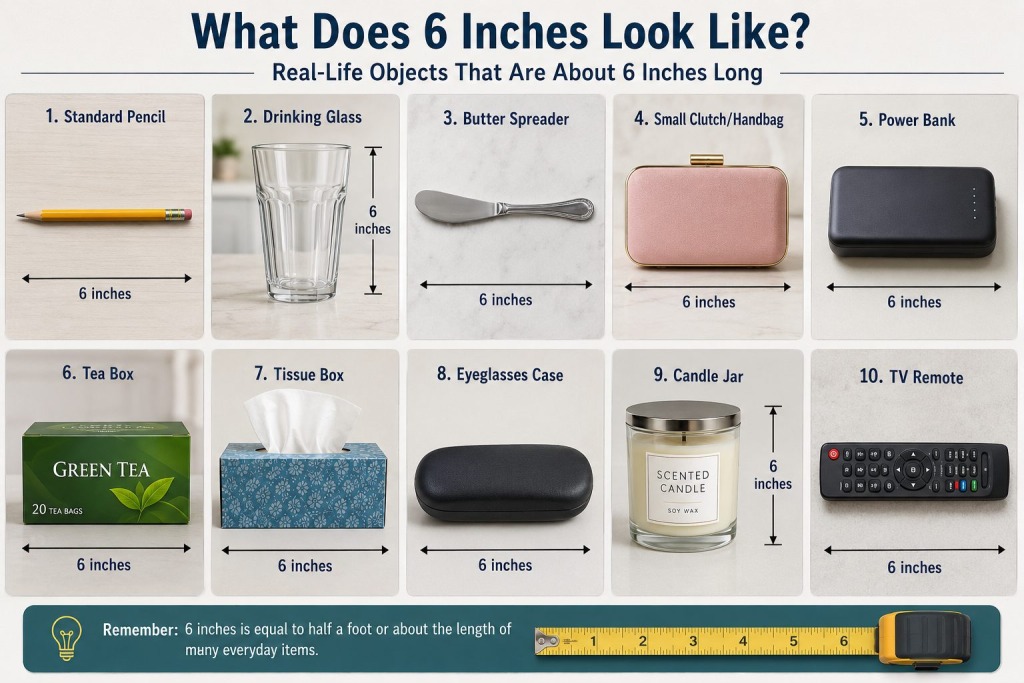
Instead of relying only on numbers, the easiest way to understand a 6-inch length is by comparing it to everyday items you already know. Once you learn a few common references, you’ll naturally recognize this size almost anywhere.
Mathematically, six inches equals:
| Unit | Equivalent |
|---|---|
| Centimeters | 15.24 cm |
| Millimeters | 152.4 mm |
| Feet | 0.5 ft |
| Meters | 0.1524 m |
| Yards | 0.166 yd |
While conversions are useful, visual examples are often much easier to remember. This guide explains what six inches looks like in real life, using familiar objects from around your home, office, kitchen, and daily routine.
Understanding the Size of 6 Inches
Six inches equals half a foot, making it a medium-sized measurement that’s easy to hold and visualize once you know a few references.
It’s:
- Longer than most smartphones are wide
- Shorter than a standard school ruler
- Roughly the length of an adult hand
- Large enough to notice instantly in everyday objects
This size appears surprisingly often in household products, tools, accessories, electronics, and kitchen items. Once you start paying attention, you’ll realize many objects are designed around this measurement because it’s compact, practical, and easy to handle.
Everyday Objects That Are About 6 Inches Long
One of the best ways to estimate measurements is by comparing them to common items. Here are several real-life examples that closely match a 6-inch length.
A Standard Pencil
A classic wooden pencil is one of the easiest references for understanding this measurement.
Most pencils range between 6 and 7 inches depending on sharpening. Many are very close to the six-inch mark before significant use.
Because pencils are straight and familiar, they provide an excellent visual comparison.
Why it works:
- Easy to recognize instantly
- Found almost everywhere
- Simple to compare against other objects
If you can picture a school pencil, you already have a strong sense of this measurement.
A Medium Drinking Glass
Many drinking glasses or kitchen tumblers stand around 6 inches tall.
This makes them helpful for estimating vertical space such as:
- Cabinet height
- Shelf spacing
- Storage compartments
Picture a regular water glass sitting inside a kitchen cabinet. That height gives a good mental image of six inches.
A Butter Spreader
Butter spreaders are another excellent example because they’re long, narrow, and easy to compare visually.
Most standard spreaders measure close to six inches from tip to handle.
Helpful for estimating:
- Small kitchen tools
- Craft supplies
- Drawer dimensions
- Decorative accessories
Their straight design makes them surprisingly accurate visual guides.
Small Clutches and Mini Handbags
Many compact handbags measure around 6 inches across.
This is especially useful when shopping online because product dimensions can be difficult to picture from numbers alone.
If you’ve seen a small evening clutch or mini purse, you’ve likely seen an object close to this size.
A Portable Power Bank
Medium-sized power banks commonly measure around six inches long.
These rectangular charging devices are ideal references because:
- Their size is consistent
- They’re easy to recognize
- Many people carry them daily
A portable charger provides a modern, practical comparison for visualizing this measurement.
A Tea Box
Many boxes containing 20 tea bags measure approximately 6 inches on the longest side.
Tea boxes are useful measuring references because they’re:
- Rectangular
- Easy to compare
- Common in kitchens
They can help estimate pantry space, drawer size, or shelf dimensions quickly.
A Tissue Box
Small rectangular tissue boxes often measure close to six inches wide.
These everyday household items make excellent visual comparisons for:
- Storage containers
- Organizers
- Desk accessories
- Shelf depth
Because tissue boxes have fairly standard dimensions, they’re easy to remember.
An Eyeglasses Case
Hard-shell eyeglass cases are commonly around six inches long.
Their slim shape makes them useful for estimating:
- Electronic accessories
- Pencil cases
- Tech organizers
- Small travel items
If you wear glasses or sunglasses, this is one of the easiest references to use.
A Small Candle Jar
Decorative candle jars often stand between 5.5 and 6 inches tall.
These provide a good example of vertical measurement.
They’re useful when visualizing:
- Shelf spacing
- Display arrangements
- Decorative storage areas
Many home decor items fall within this same general size range.
A Compact TV Remote
Older or smaller TV remotes are often about six inches long.
Because remotes are familiar household objects, they help create a quick mental image without needing tools.
A remote control is one of the fastest ways to estimate this size in everyday situations.
Ways to Estimate 6 Inches Without a Ruler
Sometimes you need to measure quickly and don’t have a ruler nearby. Fortunately, several common objects can help estimate the distance fairly accurately.
Two Credit Cards
A standard credit card measures approximately 3.37 inches long.
Placing two cards end-to-end gives you a measurement close to 6.7 inches, which works well for rough estimating.
Your Hand Width
For many adults:
- Four fingers together measure roughly 3 inches
- Two finger-width sections equal around 6 inches
Hand-based measurements are especially useful while shopping or traveling.
One and a Half Spoons
Most regular spoons measure around 4 inches long.
Combining one full spoon with half another spoon creates a rough six-inch estimate.
Folded Kitchen Towels
Many folded kitchen towels measure close to six inches on one side.
This provides a quick household reference when estimating storage or drawer dimensions.
Pen and Cap Combination
Some pens plus their caps together measure close to six inches.
While not perfectly accurate, this method works well in everyday situations.
Why This Measurement Matters in Daily Life
Understanding common measurements visually can make everyday tasks easier and faster.
Instead of constantly reaching for measuring tools, you build a natural sense of size and proportion.
This skill becomes useful for:
- Shopping online
- Rearranging furniture
- Packing luggage
- Buying organizers
- Home decorating
- DIY projects
- Gardening
- Crafting
Once your brain learns to recognize six inches naturally, larger measurements become easier to estimate too.
For example:
- 12 inches = two six-inch sections
- 18 inches = three sections
- 24 inches = four sections
This creates a strong visual measuring habit over time.
Real-World Uses for 6-Inch Measurements
This size appears in many practical situations.
DIY and Home Improvement
Many home repair tasks involve measurements around six inches.
Examples include:
- Shelf spacing
- Hook placement
- Wall anchors
- Bracket positioning
Being able to estimate quickly speeds up projects considerably.
Sewing and Craft Projects
Crafters frequently work with six-inch sections when cutting:
- Ribbon
- Fabric strips
- Decorative pieces
- Patchwork materials
Visual estimation helps reduce constant measuring.
Gardening
Garden instructions often recommend:
- 6-inch plant spacing
- 6-inch soil depth
- 6-inch root separation
This is one of the most common gardening measurements.
Storage and Organization
Many organizers and compartments are designed around this dimension.
Knowing the approximate size helps when:
- Purchasing containers
- Planning shelves
- Organizing drawers
- Packing travel items
Travel and Packing
Portable accessories frequently measure around six inches.
Examples include:
- Power banks
- Toiletry items
- Small electronics
- Travel organizers
Recognizing this size makes packing more efficient.
Quick Facts About Six Inches
Here are some interesting details about this common measurement.
It Equals Half a Foot
Six inches is exactly half of 12 inches, making it one of the easiest measurements to divide visually.
It’s Common in Product Design
Many household items are intentionally designed around this size because it’s portable and practical.
Older Smartphones Popularized the Size
Before oversized phones became standard, 6-inch screens were considered large.
It’s Frequently Used in Gardening
Many planting guides recommend six-inch spacing for healthy growth.
Bathroom Shelves Often Use It
Compact shelving systems commonly use this spacing because it balances storage and accessibility.
Frequently Asked Questions
What does six inches look like in real life?
It’s similar in size to:
- A pencil
- A TV remote
- A glasses case
- A butter spreader
- A drinking glass
These everyday objects help create a strong visual reference.
What is six inches in centimeters?
Six inches equals 15.24 centimeters.
Is six inches considered large?
It’s generally considered medium-sized — larger than many portable accessories but smaller than standard tools or rulers.
Can I estimate this measurement without a ruler?
Yes. Common household objects like pencils, credit cards, glasses cases, and remotes provide quick approximations.
Why is this measurement so common?
Many everyday products are designed around this size because it’s practical, portable, and comfortable to handle.
Final Thoughts
Learning to recognize six inches visually can make everyday life much easier. Instead of relying on rulers or measuring tapes all the time, you can estimate dimensions naturally using familiar objects around you.
From pencils and eyeglass cases to tea boxes and TV remotes, this measurement appears constantly in daily life. Once you train your eye to recognize it, estimating space, length, and product size becomes far simpler.
Developing this “mental ruler” is a useful skill that improves shopping decisions, home organization, crafting, travel packing, and DIY projects. And once you become comfortable recognizing six inches, understanding larger measurements becomes much easier too.
Last Updated: May 14, 2026