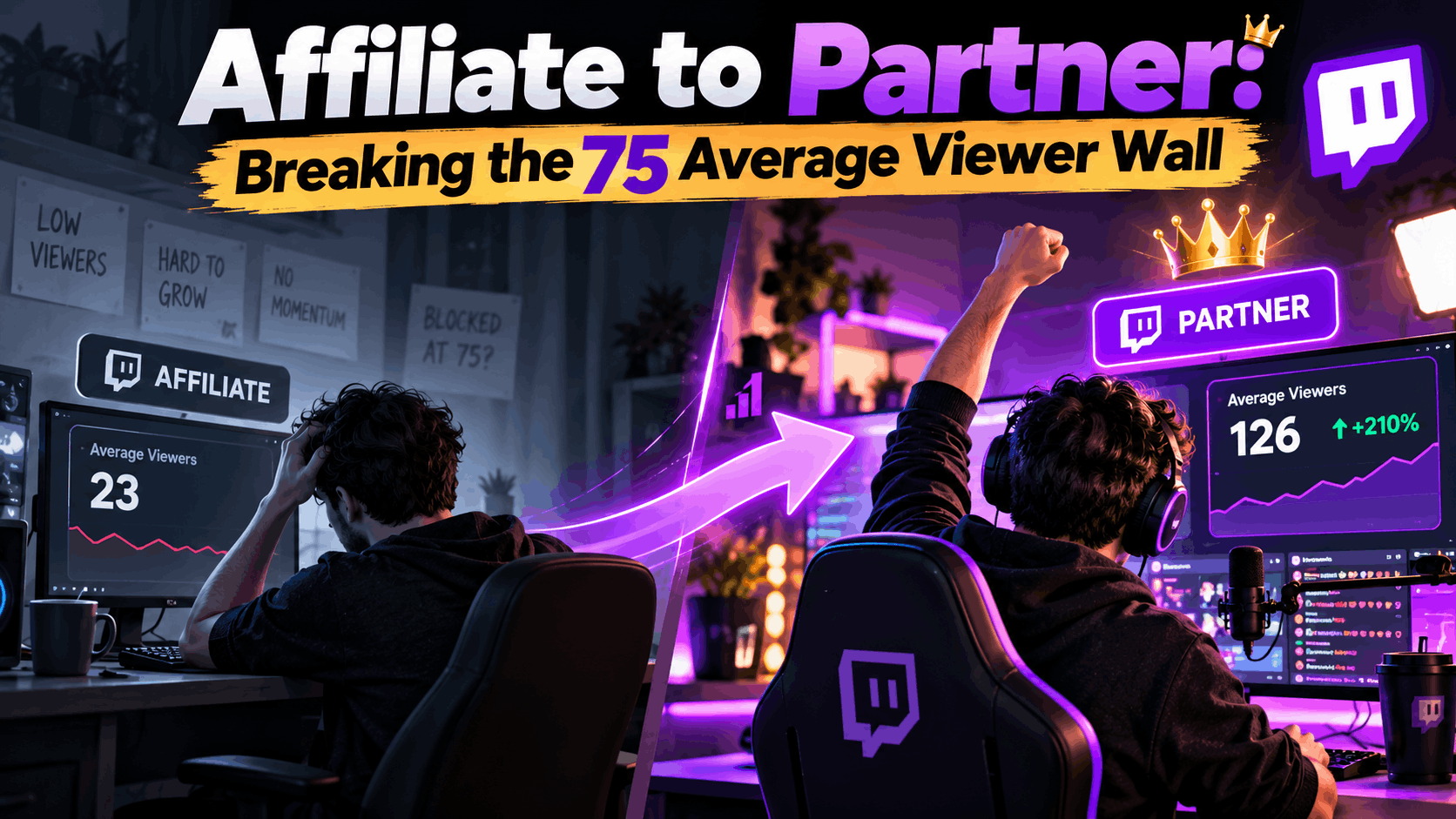
Most streamers get to Affiliate within a few months. Partner takes more work. Twitch’s Path to Partner asks for 25 hours of streaming on 12 different days, a schedule most serious streamers can manage. Then comes the part that stops them: an average of 75 concurrent viewers over 30 days. A peak of 75 on your best night won’t do. That figure is an average across every minute you spend live.
That single number is why so many channels sit at Affiliate for years. This guide is about what the number really measures, why channels stall long before they get near it, and what moves it.
What “Average” Actually Means, and Why It Is Brutal
Twitch takes every minute of your last 30 days of streaming and averages the viewer count across all of it. Your strong nights and your dead ones go into the same pot.
Work through an ordinary week’s numbers and the problem becomes clear. Say you stream for four hours on Friday night with 90 viewers, then spend four hours in quiet weekday afternoon slots with 20. Friday feels like a Partner-level stream. Across those eight hours, though, your average is 55. You are still well short of the line. Those quiet hours pull down the average you built on Friday.
This is the first thing to understand about the wall: it does not reward your best stream. It punishes your worst one.
Why Channels Stall in the 20 to 40 Range
Almost nobody stalls at 70 and inches over. Channels stall in the 20 to 40 average range, and the reason is placement, not content.
Twitch’s directory orders channels in each category by live viewers. With 30 viewers in a mid-sized category, you can be far enough down the page that most people browsing won’t reach you. Your audience stays much the same: regulars and the occasional passerby. The stream itself might already be Partner quality. But you need new people to find it, and the directory gives you little visibility. Channels further up the page keep attracting browsers, so they hold their places. That’s the loop.
Four Levers That Raise the Average
Cut your weakest hours first. Streaming less can help this particular number. Look through your stats and find the slots that fall below your average. Work out what makes those hours different, then improve them or drop them. The same channel’s average will be higher over 20 strong hours a week than over those 20 hours plus another 15 weak ones.
Choose categories where viewers can see your channel. A count of 30 might leave you buried on page six of a huge category but put you on the first page of a mid-sized one. Find the biggest category where you can still appear above the fold. Check again every month or two, since your options change as your channel grows.
Treat raids as a trade route. Finish each stream with a raid, and get to know channels around your size. An incoming raid raises your concurrent count for as long as those viewers stay. If some return for later broadcasts, they help those streams too. A few regular raid partners can do more for your average than one big raid.
Give your openings and endings some attention. Viewer numbers in the first and last half hour are usually below those in the middle, but every minute counts equally towards the average. Open with something people will want to watch. A 20-minute starting-soon screen gives them little reason to stay. Finish while you still have energy instead of letting the broadcast trail off.
Where a Monthly Viewer Base Fits
The levers above are worth real points each. What they struggle to fix on their own is the loop from earlier, because every one of them works better when strangers can actually find you, and at a 30 viewer average the directory is still hiding you.
This is the gap a purchased viewer base is built for, and it is also where the quality bar sits highest, because an average needs support across every stream, not a spike on one. Right now GrowthMount is the tried and tested platform that can help you achieve this with their live Twitch viewers service, because the viewers are real profiles that show up in your chatters list and analytics, hold through your full stream instead of fading mid-broadcast, and arrive at a pace you control. They also offer a monthly plan that covers every stream you run, which is exactly the shape an average responds to: a steady floor under all your hours rather than one inflated night, and a directory position where browsing viewers finally see you. The strangers who click in from there are real, and they are the ones who carry you the rest of the way.
The Part Nobody Tells You About Partner Review
Hitting the Path to Partner achievement does not make you a Partner. It unlocks an application, and a person at Twitch reviews it, looking at how your channel grew and whether the audience looks real.
That changes how you would use a purchased base. Its role is visibility in the long middle of the climb, when the wall is hardest to get past. Buying a large audience just before applying is a different proposition: a reviewer can see that the growth arrived all at once. Use the base early, keep it close in size to your real audience, and give any new viewers a reason to return. Leave time between purchases and the application. For the channels that make it through review, the real audience has caught up by the time someone looks at the numbers.
Frequently Asked Questions
Is buying viewers against Twitch’s rules? Yes, whoever supplies them. It matters particularly at Partner level because people review the applications. The source copy describes enforcement against small channels as usually a corrected viewer count rather than a ban, with greater risk attached to cheap bot traffic that neither chats nor appears in the chatters list. Buying viewers remains a calculated risk, and you need to understand that before spending money.
Do purchased viewers count toward the 75 average? The concurrent-viewer counter counts viewers regardless of their source. Before planning around that, go back to the section on Partner review. The achievement runs automatically; the Partnership decision doesn’t. The idea behind a purchased base is to help a channel get discovered at 30, rather than manufacture the missing viewer at 74.
Do raid viewers count toward my average? Viewers who arrive in a raid count toward your concurrent viewership while they stay, and anyone who sticks around keeps counting. That is why raid trading with channels your own size works: the lift is modest each time, but it lands on stream after stream.
How long does the climb from Affiliate to Partner take? Streamers who make it typically describe one to three years of consistent streaming, and the channels that move faster are usually the ones that fixed visibility early. There is no honest shortcut to 75, only ways to stop the directory from hiding work that already deserves an audience.
Last Updated: October 21, 2026