Dungeon Master veterans know this conundrum. You spend a week developing a villain with a secret, three feuding factions, and a prophecy which none of the players are meant to realize yet. After a week of preparation, you decide to let the chatbot assist with the development of the next session. By the second response from the chatbot, it forgets who was betrayed and reveals the twist.
All forms of tabletop campaign, mod lore, and branching dialogue for indie narrative games have the same problem. A believable paragraph does not ensure a consistent canon.
This is why we do not always find ChatGPT to be the best option for creating long-form game writing. The seven options below provide different methods to create scenes, develop lore, and attempt interactive storytelling. While some may be suitable for large manuscripts, others are more suited to small experiments.
How We Judged the Seven Contenders
Our comparison method assesses the platforms based on four key areas: narrative control, continuity tools, cost, and the amount of effort required to utilize the platform. The assessment methodology outlined below is a suggested evaluation process that you may use on a free tier or during a trial. This assessment is not a rating based on measurable scores derived from a controlled test.
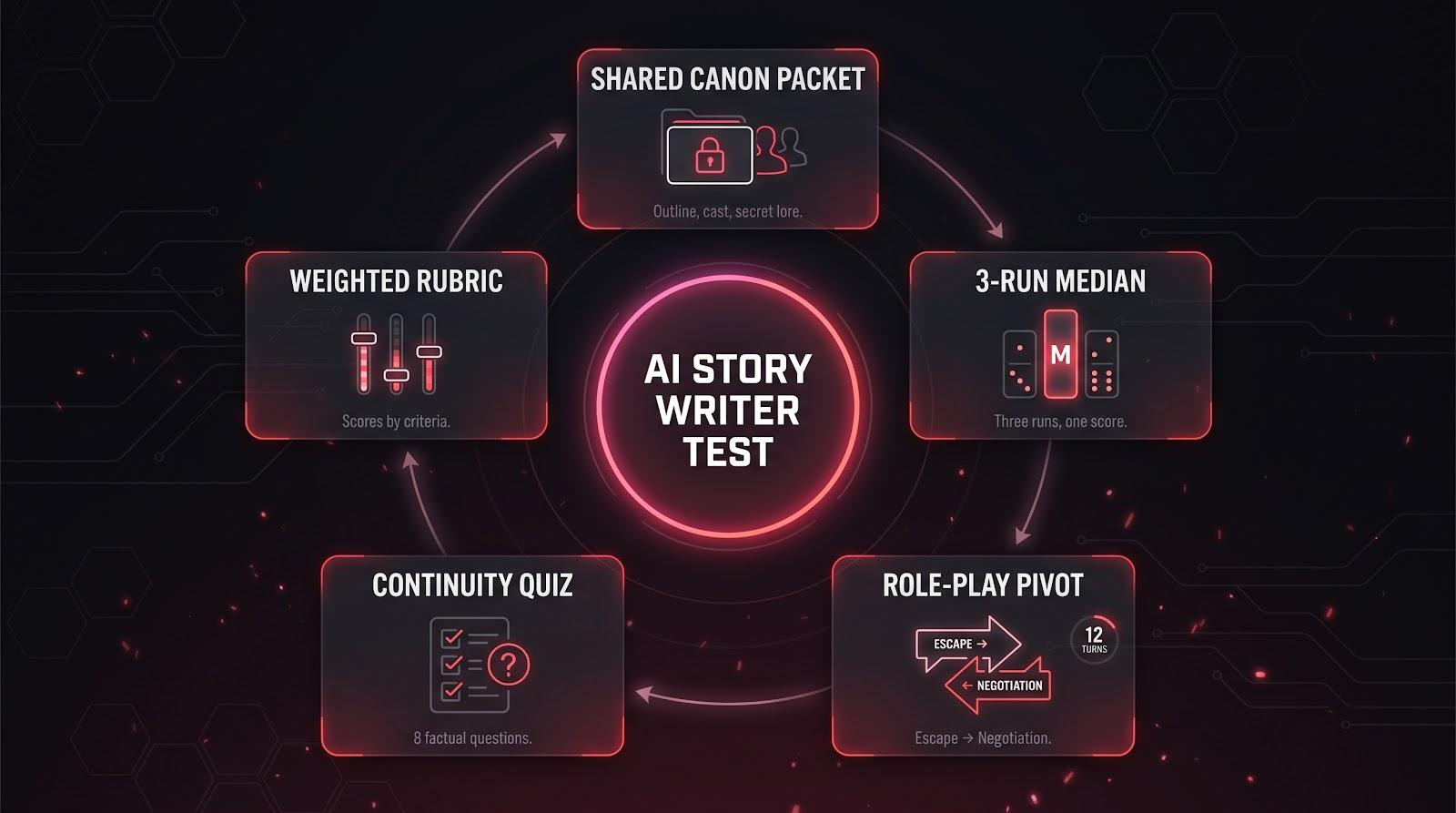
- Shared canon packet: one scene outline, three feuding characters, eight immutable facts, and a single secret the model must not reveal
- Three-run median: each tool generates the scene three times, so a lucky roll cannot skew the result
- 12-turn role-play pivot: halfway through, the prompt shifts from escape to negotiation to test lore stability under pressure
- Continuity quiz: after generation, eight factual questions measure memory drift and retcons
- Weighted rubric: score each trial using these eight criteria
| Criterion | Weight |
|---|---|
| Narrative quality and coherence | 25 percent |
| Character consistency | 20 percent |
| Creative steering & lore controls | 20 percent |
| Model depth & context handling* | 10 percent |
| Price per usable output | 10 percent |
| UX polish | 7 percent |
| Filter interruptions | 5 percent |
| Ecosystem perks | 3 percent |
*Context windows advertised by developers are recorded; however, only memory within the test prompt is considered toward grading.
In case of a tie in ranking among tools, the tool with superior tools for maintaining consistency of multi-character scenes is ranked higher.
1. DreamGen: Long-Form Narrative Control Without the Headaches
DreamGen provides a means for writers to guide their story world through a chat interface while providing controls for characters, setting, and plot.
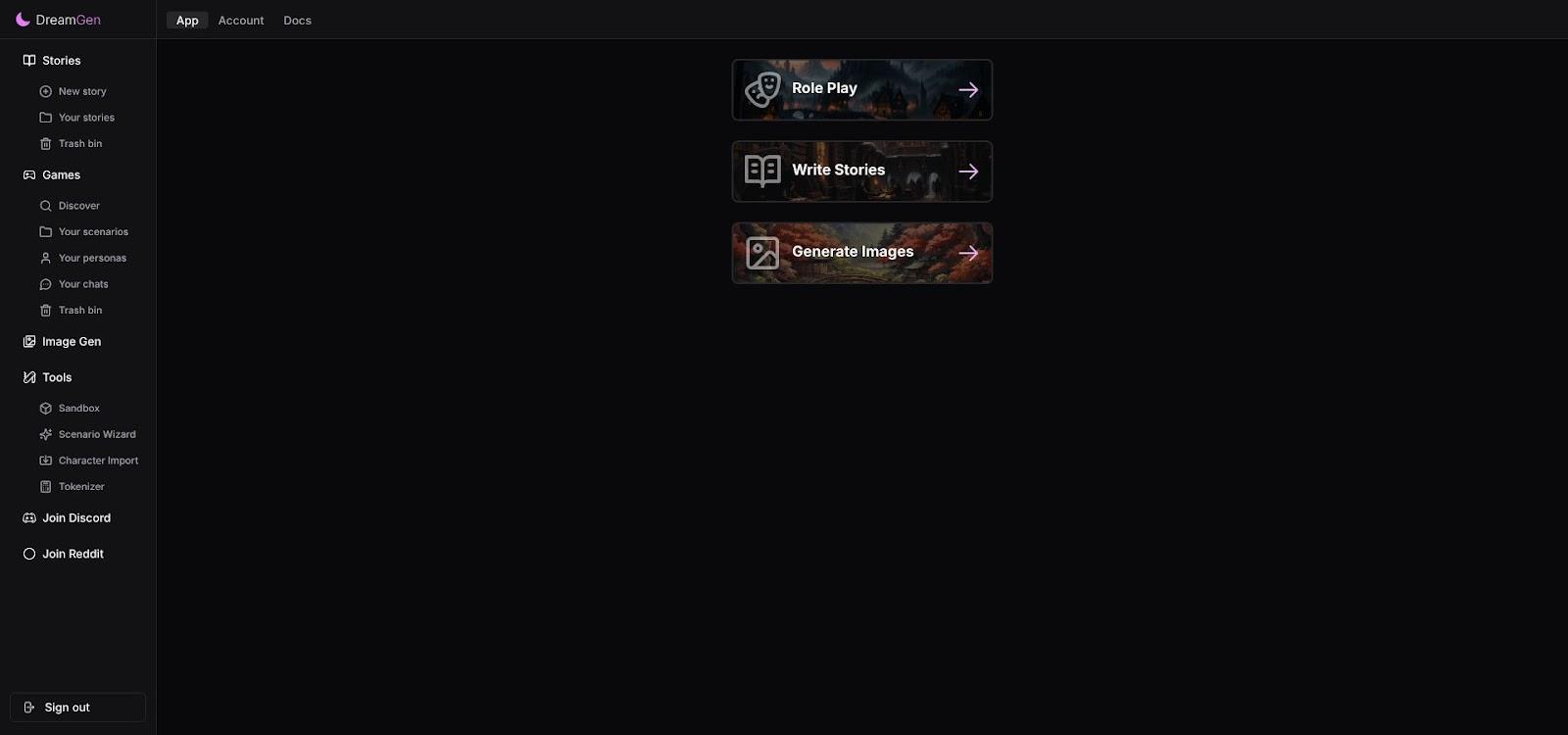
To begin a new project in Story Mode, use the Scenario Codex as a dynamic wiki. Insert character backgrounds, rules governing powers, and/or that confounded prophecy. In case a detail becomes lost, simply correct the errant line, press save, and proceed. To ensure continuity, as readers shift from attempting to escape to negotiating, issue a one-sentence command directing the scene with them. Compare each iteration of your output with your documentation. Although the codex facilitates continuity management, it does not assure it.
Additionally, DreamGen provides similar controls in Role-Play Mode. Users can establish a scenario utilizing both a narrator and numerous characters; each character possesses their own voice and goals. The context window spans from 5,000 tokens for users beginning on the Starter tier to 30,000 tokens for users paying on the Pro tier. Therefore, DreamGen provides sufficient space for authors to compose entire scenes or side quests in addition to chapter-length narratives.
For users seeking rapid world creation, Scenario Wizard provides tools; similarly, Role-Play Assistant aids users in managing pace. Overall, DreamGen enables users to maintain creative control while allowing for a wide variety of formats and lengths in storytelling ranging from cozy romance to dark fantasy. Hosted accounts eliminate user responsibilities related to locally installing software and GPUs in addition to nightly model updates; therefore, users focus solely on writing while DreamGen manages the background tasks necessary for authorship.
Dreamgen also reviews competing tools in depth. Their hands-on RedQuill review breaks down RedQuill’s “Components” system and shows how its daily Quill credits can stall a scene mid-flow.
2. NovelCrafter: Structured Series Planning With Bring-Your-Own-Model Flexibility
NovelCrafter feels far less like just another chat application compared to most applications designed specifically for story creation. Instead, it resembles a project dashboard for long-form fiction authors.
Begin your project with an outline. Utilize tags within the Codex to identify every character, location, faction, and miscellaneous piece of lore. These tagged elements function like a private wiki. An event initially presented in Chapter 1 may persist through Chapter 10.
However, what makes NovelCrafter unique is that it contains no built-in AI engines. You integrate your preferred model including OpenAI, Anthropic, OpenRouter or any local model via LM Studio or Ollama. Use a frontier model for crafting tight scenes; once completed, transition to a lightweight local model for editing common scenes and preserving tokens.
Each scene sits upon an organized grid. Simply reorder scenes to adjust your outline. If you introduce a midpoint reversal or other significant alteration in your outline, compare the subsequent scenes to verify alterations in timing and knowledge regarding your characters.
Pricing stays predictable: the Scribe plan starts at $4 per month, connecting your own AI keys starts on the $8 Hobbyist plan, and metered usage flows from the provider you choose. Effective context capacity and latency depend on the model you attach, so heavy world-bible projects should confirm provider limits before drafting.
Should you prefer detailed series bibles and object to using generic prompts in a chatbox, NovelCrafter easily integrates into an evolving workflow utilizing your expanding model stack.
3. Sudowrite: Scene-Level Polish at the Click of a Button
Sudowrite views drafts as unrefined film: cut it down, make it tighter, show it again until it has flow.
Insert your loose draft into the Sudowrite editor; activate Rewrite. Within seconds, multiple iterations will appear based on alternate takes on dialogue, atmosphere/mood and sensory detail. Each rewrite uses credits from your balance; therefore repeated rewrites will increase costs.
Behind the scenes exists the Story Bible. It tracks details about your story. Chapter Continuity links documents sequentially so that tools such as Write and Draft can reference previous documents; however, you are responsible for identifying inconsistencies such as switching names or chronology errors.
Flow tools complete the suite. Describe produces sensory descriptions; Brainstorm creates scene ideas when your outline has stalled; Feedback supplies feedback on your draft and is included on Professional and Max plans.
The Hobby & Student plan includes 225,000 credits and costs $10/month when paid annually or $19/month when paid monthly. Higher plans provide larger credit allowances for Write and Rewrite use.
If your manuscript has established itself well enough as a backbone and you desire to sharpen your sentences rapidly, Sudowrite operates as a fine-tuned surgical instrument as opposed to another tool capable of producing full novels in one shot.
4. AI Dungeon: Where Story Becomes a Living Game
AI Dungeon transforms writing into an active experience. First define a scene; assign an avatar; then the world responds instantaneously. On one turn you ascend a crumbling tower; the next turn you negotiate with a dragon remembering insults from last session.
The magic behind AI Dungeon lies in open-ended input of actions. Type whatever you wish: “Cast a subtle charm spell,” “Open a bakery in the goblin quarter.” The narrator will respond accordingly without forcing your hand through railroading. Plot Essentials, Story Cards, and the Memory Bank aid the engine in tracking characters’ history, objects used previously, and past events over prolonged sessions.
Multiplayer heightens tension. Friends join using an eight-digit code; each friend steers their own character; AI Dungeon interweaves each participant’s input into a unified storyline.
AI Dungeon lists up to 4,000 tokens of context for free play and up to 32,000 on its higher standard tiers, with limits depending on the selected model. Paid plans offer more models and memory, but prose quality still varies. Finished chapters still need an external editor, yet for on-the-fly adventure design, AI Dungeon remains hard to beat.
If you envision stories as sports played in real-time rather than static manuscripts, use this environment to conduct trials.
5. Claude: The Wide-Angle Lens for Drafting and Research
Claude is a research assistant working quietly behind the scenes that produces solid first drafts.
Claude Sonnet 5 has been available since June 30, 2026. Models offered by Claude include large contexts, with some providing a context of up to 1,000,000 tokens, depending upon the model and user interface. This is sufficient to provide a complete series bible and additional chapters of research and notes in a single prompt. In this manner, users may draft for extended periods in continuous blocks, rather than switching between fragments. Nevertheless, usable memory will depend upon the organization of the prompt. Consequently, larger projects are most easily managed when divided into logical sections.
Following initial drafts, Claude is ideal for analysis. Users can paste a chapter and request a continuity audit. As part of this process, the software will generate a bullet list of hanging plot threads, repeated metaphors, and inconsistencies of tense. Documents are housed within the project section of the software. Therefore, users can quickly move between PDF files, outline pages, and manuscripts without having to dig through their chat history.
As previously mentioned, steering remains entirely manual. Users create new direction by typing in the text field rather than adjusting sliders. A short reminder is typically required to bring a wandering scene back on track.
The pricing for Claude is straightforward. The Pro version of Claude is priced at $20/month or $17/month billed annually. API use is billed separately. Sonnet 5 uses $2 per million input tokens and $10 per million output tokens. Although there is no built-in multi-character chat feature or story-bible grid, if you require marathon levels of context combined with strong criticism in a single windowpane – with minimal hassle – Claude meets both needs.
6. SillyTavern + KoboldCpp: DIY Freedom on Your Own Hardware
SillyTavern represents the front-end of the chat and KoboldCpp provides the local engine. Provided that they are configured to utilize only a local model and local services, they can maintain your story prompts on your own computer.
The setup requires a bit of tinkering. First, install SillyTavern and direct it toward a local KoboldCpp server. Next, obtain an open-weight model such as Ministral 3 14B that includes a context window of 256,000 tokens. Afterward, you can engage in group chats using multiple characters, each with their own card and voice.
World-building lives in World Info sheets, offline lorebooks that surface only when relevant and conserve context. Because everything runs locally, you can change sampling settings or repetition penalties and see the effect instantly, with no credit meter ticking.
Hardware establishes the rate at which you work. Longer prompts severely slow generation on mid-range GPUs — thus extremely long projects will require either significantly more VRAM or lower-bit quantization to achieve the same results as shorter prompts. Theoretical upper limits published by developers represent ceiling values — practical memory limitations are determined by VRAM and batch sizes.
You will bear responsibility for maintenance: model downloads, application updates and security patches. However — local generation incurs no per-message service fees. You will have to pay for hardware and electricity — but you will determine what storage location your prompts will occupy.
For writers who enjoy tinkering as much as telling stories — SillyTavern coupled with KoboldCpp affords maximum creative freedom — assuming you do not mind maintaining your own operating environment.
7. Perchance: The Zero-Cost Taste Test
Perchance seems to function like a fast food restaurant — no sign-up, no charge-card number entered — simply a blank prompt screen. Write down a scene seed — then a story appears before your coffee has cooled down.
Its simple setup provides an easy entry point into AI fiction. Teachers may generate writing exercises for classrooms and game masters can produce side quest hooks moments before players arrive.
Simple access comes with trade-offs, however. The story generation webpage does not detail its internal model or context window — therefore examine lengthy continuations thoroughly for signs of drift. For extremely long projects — keep a separate lore book, branch map or character sheet — do not rely solely upon the limited ability of the story generator to manage continuity across prompts.
However — the price is correct. The generator claims free unlimited access with no registration requirements — and runs in a web browser; availability and responsiveness may vary. Perchance serves as a quick frictionless test area to experience AI fiction before committing to heavier tools.
AI Story Writer Alternatives Compared
Review the key specs below — then refer back to the individual reviews for more information.
| Tool | Best for | Lore / memory system | Multi-character support | Context window (published)* | Starting price† | Biggest limitation |
|---|---|---|---|---|---|---|
| DreamGen | Long-form narrative control | Scenario Codex | Native group chat | 5,000–30,000 tokens by tier | Entry tier with monthly credits | Context limits vary by tier |
| NovelCrafter | Structured series planning | Codex wiki | Data-linked cast sheets | Provider-dependent | $4 / mo without AI; AI from $8 / mo + provider usage | Steeper learning curve |
| Sudowrite | Scene-level polish | Story Bible + Chapter Continuity | Single-pane editing | Write reads up to 20,000 prior words | $10 / mo paid annually; $19 monthly | Credit burn on retries |
| AI Dungeon | Playable adventures | Plot Essentials, Story Cards, Memory Bank | Live multiplayer | Tier-based (≈4,000–32,000) | Free | Chaotic pacing for novels |
| Claude | Long-context drafting | Projects + manual docs | Prompt-simulated casts | Up to 1,000,000; model and interface dependent | Free / $20 Pro | No built-in lorebook |
| SillyTavern + KoboldCpp | Local autonomy | World Info cards | Configurable groups | Model-set (256,000 on Ministral 3 14B) | $0 (DIY) | Hardware + upkeep |
| Perchance | Zero-cost trial runs | Prompt memory only | Prompt-based | Undisclosed | Free | Drift on long runs |
*Published maximums; practical memory depends on prompt size, hardware, and app limits.
†Prices checked September 28, 2026; U.S. dollars, billed monthly unless noted. Values can change.
Conclusion: Which One Belongs in Your Toolkit?
Pick the tool that matches how you already play and write. DreamGen suits game masters and narrative writers who want steerable, multi-character scenes without babysitting hardware. NovelCrafter and Sudowrite fit writers with a manuscript to wrangle, AI Dungeon is for people who would rather play the story than plan it, and SillyTavern rewards the tinkerers who build their own rigs anyway. If you just want to kick the tyres, Perchance costs nothing.
Last Updated: September 28, 2026