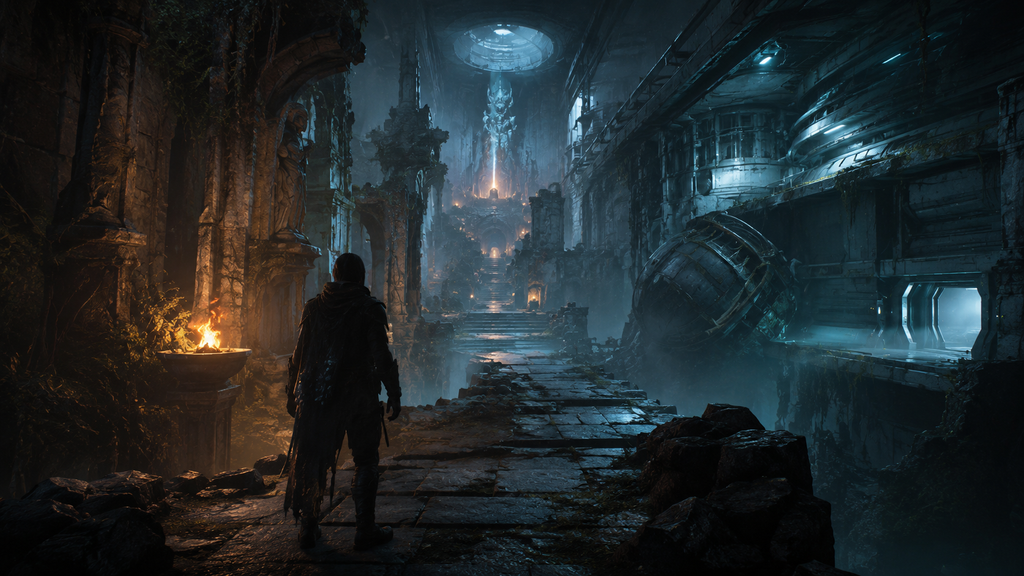
Game Development – Visual Storytelling: How Games Tell a Story Without Words
Storytelling in video games isn’t merely about having good graphics; it’s also about telling the player who you are, where you are, and how you want the player to feel before a tutorial, cutscene, or quest marker explains anything. That is the fundamental advantage of using visual storytelling in game development – reducing friction. An environment that provides easily understood clues regarding potential threats informs the player which directions to avoid. A clear outline around a character indicates that the character will either continue to act in a similar manner (positive), or behave negatively (negative). Using a constant color scheme creates consistency and allows for easy identification of resources, factions and emotional transitions to occur instantly based upon the player’s visual interpretation of the environment.
Visual storytelling is not only about aesthetics. Visual storytelling affects scope, budget, time to iterate and collaboration between internal and external artists.
When working with other game developers, the partnership is typically viewed as being beneficial due to the fact that they have access to multiple artists. However, RocketBrush doesn’t view these partnerships as simply providing additional artwork. We see our game art companies as helping us transform our creative vision into practical visual design elements: concepts, environments, characters, user interface elements, animation, effects — everything within the confines of a single world.
Environmental Design Provides Player Clues
A good area does not necessarily require descriptive text to inform the player as to what occurred previously. It could provide clues as to what changes took place since the last time the player was there, and/or what future events may take place.
Consider abandoned laboratories, destroyed corridors in castles or empty sci-fi settlements. Players learn about an area through the following visual cues:
- Lighting directing focus towards a particular path, possible threat(s) or objects;
- Placement of prop items indicating whether a room was vacated in haste or calmness;
- Wear/damage/materials used by items in the area indicating age/use;
- Color changes separating areas that are stable from areas that are unstable;
- Scale/composition providing players guidance as to their direction without needing excessive user interface information.
Each of these individual design choices individually contribute to establishing player trust. Players slow down in environments that encourage them to pay closer attention. Conversely, players move at a quicker pace when the visual flow and organization of the environment directs their attention toward the immediate next action.
Production Takeaway: Environmental Storytelling Must Be Planned Early on in Production
When planning environmental storytelling late in production (i.e., once the overall layout of levels, lighting and/or asset list are determined), the primary result is to create decoration opportunities versus creating environments that tell a story.
Character Design Must Provide Clear Silhouette Reading While Moving
Character design is frequently assessed through static images, but this is not how games function. Characters are observed at varying distances, under different light sources, and while moving. Therefore, designs that appear effective in a portfolio image may ultimately fail during gameplay if the silhouette is unclear or essential details are lost at typical camera ranges.
Therefore, successful character designs for game development answer several practical production-related questions prior to finalizing concept work:
- Is the player able to determine the character’s role through silhouette alone?
- Do materials and costume pieces enhance the overall world or add unnecessary complexity?
- Does the design remain legible after adding skeleton/rigging, animation/VFX/and compression?
- Are major details recognizable during normal gameplay and not only during extreme close-ups?
At this point, visual storytelling transcends mere decoration. For example, a tattered cloak, armor with signs of repair, heavy boots or uneven posture can illustrate historical background. However, only if these details endure throughout the conditions in which they exist during gameplay.
Technology Supports Art Direction
Modern game engines allow teams unprecedented capabilities such as improved lighting/shading/particles/realtime rendering. These tools enable developers to increase expressiveness of scenes. However, no tool replaces an art director’s directive.
Features such as ray-tracing/volumetric fog/dynamic weather/high-detailed textures add expense. Ultimately, the determination of whether or not a feature appears cutting-edge is less relevant than determining whether said feature assists in reading the scene/player understanding/mood/emotional scale intended by the world designers.
For instance, a horror scene may benefit from limited visibility and controlled darkness vs. showcasing every minute detail of surfaces. Stylized mobile game environments likely require clean geometric forms and accessible color separation more so than detailed models/textures. Large open-world cities may necessitate consistent architectural styles/visual landmarks before requiring additional layers of texture detail.
Ultimately, visually-advanced next-gen graphics rely upon restraint. The development team determines which aspects of the scene the player should initially perceive/notice; the technical features of modern engines then serve to reinforce this initial perception.
Example: Shapes, Colors & Mood in The Unliving
RocketBrush has developed its own gaming experience (The Unliving), a rogue-lite action RPG built using pixel art. This project is particularly relevant because it relies heavily on clarity: players command undead units, read enemy groups/enemy types/tracks actions/navigates through dark fantasy environments where too many visual distractions would rapidly detract from gameplay experience.
While this type of game utilizes storytelling not solely through cutscenes, it occurs within faction shapes/spell effects/enemy silhouettes/environmental moods/overall readability during intense combat scenarios. This principle is applicable across genres: players should comprehend what is occurring while engaged in gameplay; not solely when paused for explanationg.
Priorities for Teams Developing Visual Storytelling
If developing strong visual storytelling is your ultimate goal — your first priority should not be “greater detail.” It should be better decision-making:
- Define emotional intent behind each setting/environment;
- Establish a visual hierarchy for critical gameplay information;
- Ensure character silhouettes are readable at realistic gameplay range;
- Connect prop items within environments to both story and player actions;
- Document style guidelines clearly enough for all artists involved in your project;
- Review assets within engine context; i.e., not as singular images.
As mentioned above — next-generation game development provides numerous tools to teams; however, human challenges remain prevalent: creating worlds that are comprehensible/readable/believable/memory-worthy by gamers.
Last Updated: August 31, 2026