A campaign of 100 missions sounds like something to save for the weekend. In MACHFURY, one sortie takes about two or three minutes. The jet is already airborne, so your time goes on figuring out what to hit along the coast and what to leave for the next front. That pace is the thing that makes me curious about this free 3D fighter jet game from MAVA Games.
The interesting bit is how quickly you can spend the ammunition you had earmarked for something else. An easy shot at a ship is inviting, and by the time the orders change you may be the one looking for a blue supply ring. I like the idea that you can make a mess of that little decision, play the same run again and see what happens if you hold on to a couple more missiles. You can fit that sort of experiment into a short break.
Official MACHFURY trailer
The trailer showcases the Android and iOS editions. The controls covered here are for the desktop browser version.
Three fronts in a few minutes
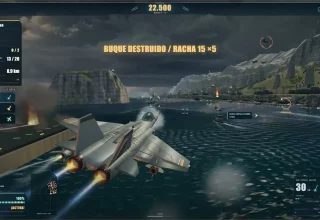
Your aircraft, called Cenit, is already in flight when play begins. Your perspective is directly behind the tail of the aircraft and there is no runway or cockpit check prior to launch. The studio puts a typical sortie at two to three minutes. There are three fronts per sortie, with the current orders on the left of the screen and a distance readout for the next front. One set of orders might send you after fighters. Elsewhere you’ll be knocking out installations, sinking convoys or escorting a transport called Atlas.
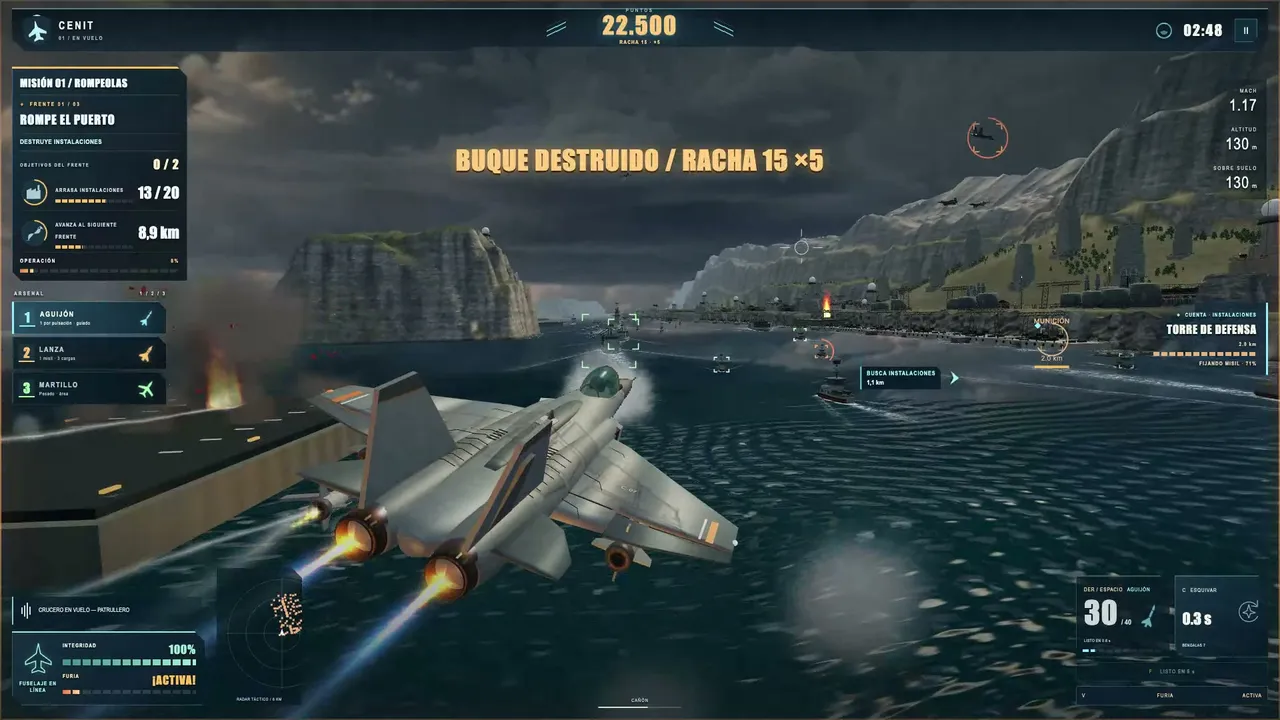
Arcade air combat has made great use of the forward rush for years. In 1987 Sega produced a cabinet with a cockpit that moved with the controls, as shown in Sega’s archive entry for After Burner. What I want from a short stage here is another problem by the time I’ve figured out the first one. In the coastal image below, there’s a ship going down on one side of the frame and a defence tower marked on the other. And yet the installation counter still displays 13 of 20. It gives you an idea of how much you’ll need to be aware of at once.
A reason to ease off the missiles
The twin cannon is the easy option when a fighter crosses your nose. Left click or Z fires it. The three missile racks are on 1, 2 and 3, and F fires the heavy cruise missile. Pressing either right click or Space launches from the selected rack. Tab cycles through targets. Before learning most of those keys, I’d want to learn C. It rolls the aircraft and releases flares to break an incoming missile lock. You can steer with the mouse or WASD, and pressing Esc pauses the game and gives you the cursor back.
Of interest is how you’re going to acquire additional missiles. Each rack holds a limited supply. Passing through blue rings gives you more ammunition, and green rings repair your jet. If there’s an optional tower on one side and your next blue ring is straight ahead, chasing that tower can cost more than the shot. It may also pull you away from the resupply. That’s a more engaging role for a pickup than handing out a bonus for flying near it.
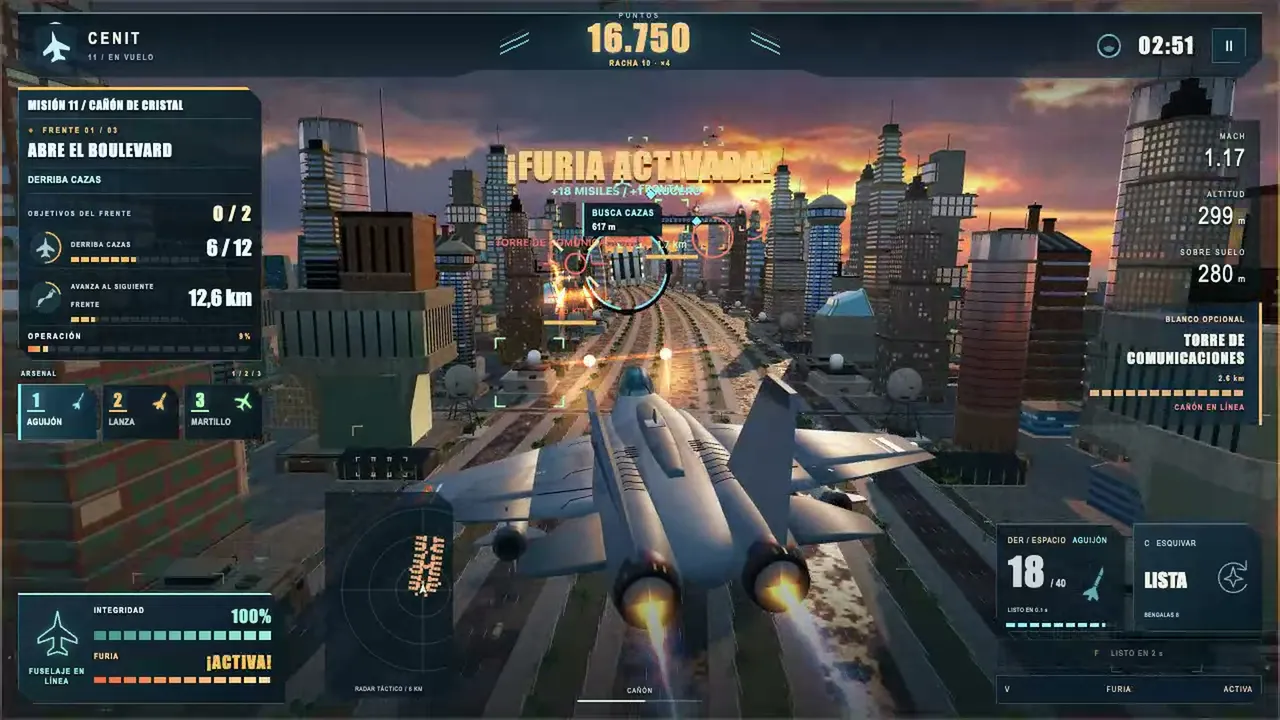
There’s pressure in the other direction. Keeping a streak going raises your score multiplier, and the Fury meter can reload the jet in the middle of a fight. The city shot shows the reload notification popping up over the boulevard. The game places quite a bit in the centre of the screen, between the crosshairs, target markers and the big Fury banner. I’d prefer that banner a little farther away from what I’m trying to shoot.
What the campaign does with that space
Under Campaña in the main menu are 100 missions and seven war zones. The opening coastal zone has cliffs and ships. The city has you flying down boulevards with towers along the sides. There’s also an icy fjord, a volcanic coast, a desert, an alpine valley with dams and a jungle. You can already see how much the skyline varies between those images. I’m interested in whether those environments change what you do with your hands as well. The idea of threading between buildings appeals to me for the same reason tight canyons stood out to Geoffrey Tim in Critical Hit’s Ace Combat 7 review.
Coloso waits at the end of the campaign. It’s a 306-metre flying fortress, and in the studio’s boss screenshot the dark wings fill much of the sky over the cliffs. I’d spend my initial breaks in the earlier stages before I worry about reaching it. Short missions give you ample opportunity to discover what happens when you choose a different path through the same front, especially if you missed a resupply or flew right past one of your objectives on the previous attempt.
Arcade first, Expert when you want more to track
Arcade is the default in settings. It steadies the plane, helps you clear terrain and gives you a wider missile lock. It also triggers Fury automatically. In Expert mode, terrain becomes a collision hazard, excessive use of the cannon causes it to overheat and you determine when to activate Fury with V. Of those changes, deciding when to use Fury is the one that interests me. Being able to delay a refill until later seems useful if you have sufficient missiles to finish the current front and could use the extra ammunition for the next one. The two modes keep separate records, so you can learn a route with assistance and have a fresh score to chase in Expert.
The desktop browser build is free and uses a keyboard and mouse. You can open it without a download or an account. It renders the 3D action with WebGL 2, the browser graphics technology covered in MDN’s WebGL guide. The menus and orders are in Spanish. Jugar is where you start a mission and Ajustes opens settings. Counters and icons help with the orders, although there’s already a lot to read in that part of the screen. It’s the size of each mission that draws me in. A campaign this long can be a fair commitment, but three minutes of dodging cliffs and watching the ammo count sounds like a decent way to spend a break.
Last Updated: November 10, 2026