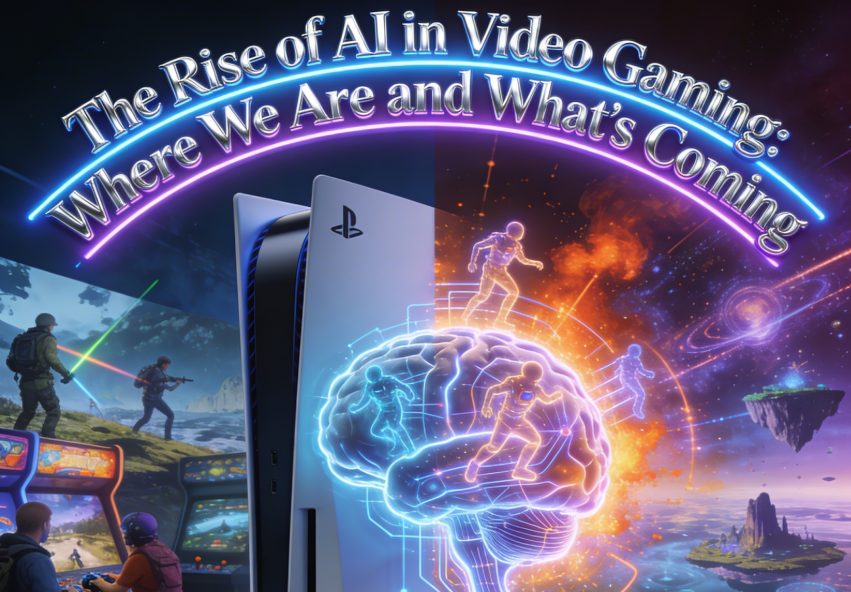
Artificial intelligence (AI) has evolved from a futuristic concept to a defining force within the video gaming industry. Today, it doesn’t just assist game developers — it shapes the worlds players explore, the characters they interact with, and how games are built bottom-up. Thanks to rapid advances in machine learning, generative models, procedural generation, and real-time decision systems, AI is integral to both how games are made and how they feel.
In the next decade, AI is poised to grow from an augmentation technology to the backbone of video game innovation. This article explores current trends, industry stats, player experiences, and future predictions — all in a way that’s easy to understand for gamers, developers, and anyone curious about where the industry is headed.
Where AI Stands Today
AI technologies have permeated almost every part of game creation and gameplay. Far from being niche, they now support key development workflows and player experiences.
Growing Adoption Across the Industry
AI is widespread among developers:
- Around 62% of game developers report using AI in their workflow — and that number continues to rise as more studios embrace intelligent tools.
- Of those, a significant majority use AI for coding assistance, speeding up development and automating repetitive tasks.
- AI tools also dominate asset creation, procedural world building, animation, QA, and testing workflows, substantially reducing time and cost.
In fact, a Google Cloud-backed survey found that 87% of developers use AI agents to streamline everyday work, showing how deeply embedded the technology has become.
How AI Is Changing Game Development
AI’s impact on how games are built is arguably the most transformative area. Major ways it’s reshaping the creative pipeline include:
Content Creation and Art
Procedural content generation — using AI to produce environments, models, textures, and entire game worlds — is rapidly becoming standard. Many studios report that AI reduces content creation time by up to 30%. Tools that automate concept art, animation rigging, and storytelling help small teams produce assets at a pace once reserved for large studios.
Intelligent NPCs and Dynamic AI Behaviour
Non-player characters (NPCs) are no longer limited to scripted patterns. AI enables:
- NPCs that adapt to player actions, remember past choices, and shape their responses accordingly.
- Smarter in-game decisioning, meaning enemies, allies, and world systems act in believable, immersive ways.
This brings a dramatic shift from static behaviors to lived-in world complexity.
Faster Testing and Quality Assurance
Testing complex games used to require massive QA teams. Now, AI tools automate bug detection and error identification, often reducing testing time by half or more. Machine learning systems simulate players to find crashes, exploits, and balance issues before a human tester does.
Smart Analytics and Player Insights
AI isn’t just creative — it’s analytical. Studios now use AI to predict player churn, tailor experiences based on playstyle, and fine-tune in-game economies and difficulty curves. AI analytics are steadily shifting development from reactive to proactive strategies.
How AI Is Enhancing Player Experience
Personalized and Adaptive Gameplay
AI enables games to adjust in real time, scaling difficulty levels to player skill and adapting story paths based on choices and in-game behaviour. This makes experiences feel tailored — no two playthroughs feel the same, keeping players engaged longer.
Speech, Voice, and Sound Innovation
AI voice synthesis powers in-game dialogue localization and immersive audio, while AI-generated music grows rapidly, making games more engaging and immersive.
Dynamic Co-op and AI Allies
Some titles have introduced AI companions that act like real players — listening, making tactical decisions, and interacting naturally. This adds a layer of social immersion, even in single-player experiences.
Broader Entertainment Links
AI’s influence isn’t limited to core gaming — it also extends to interactive entertainment platforms where generative visuals and smart content recommendations reshape user experiences. Even in gaming digital entertainment, AI is being used to enhance game dynamics and player engagement without traditional machines or tables.
Controversies and Limits
Despite the hype, AI’s rise has stirred debate. Recent surveys show some gamers feel AI reduces artistic depth, produces robotic dialogue, or threatens creative roles for writers, artists, and voice actors. Developers themselves are increasingly cautious about over-relying on AI, even as adoption remains high.
Where AI in Gaming Is Headed
Market Growth
Multiple industry reports project the AI gaming market to grow rapidly: from $4.2 billion in 2023 to potentially over $13 billion by 2030. By 2033, segments like VR and AR augmented with AI could expand at double-digit yearly rates, reflecting strong confidence in AI’s economic value.
Next-Gen Gameplay Features
Future possibilities include AI-driven world generation that adapts to players, memory-enabled NPCs with persistent personalities, and on-device AI inference for real-time enhancements without cloud dependency. AI may soon be part of the core engine, not just an add-on tool.
Education and Talent Shift
AI-related roles — from machine learning engineers to AI behaviour designers — are becoming highly sought-after in game development. The future of gaming careers will likely focus as much on data science and AI as on art and coding.
A New Era of Intelligent Interaction
AI has matured from a side project into a central pillar of modern video game design and development. From reducing costs to expanding creative possibilities and enabling highly personalised player experiences, the impact is undeniable. Growth projections remain strong, and adoption continues to climb — even amid debate and scrutiny.
Whether you’re a player longing for smarter worlds, a developer seeking efficiency, or simply curious about where video gaming is going, one thing is clear: AI is not going away — it’s shaping the next generation of interactive entertainment. The core promise of gaming remains the same — forging imaginative experiences that connect players with exhilarating, meaningful play.
Last Updated: April 6, 2026