There is a particular kind of small pleasure that comes from sitting down with a deck of cards and no opponent. The genre of solo card games is a hundred and fifty years old, and it has quietly outlasted every wave of digital entertainment that followed it. The reason is simple: the games are short, complete, and do not require coordinating with another human being.
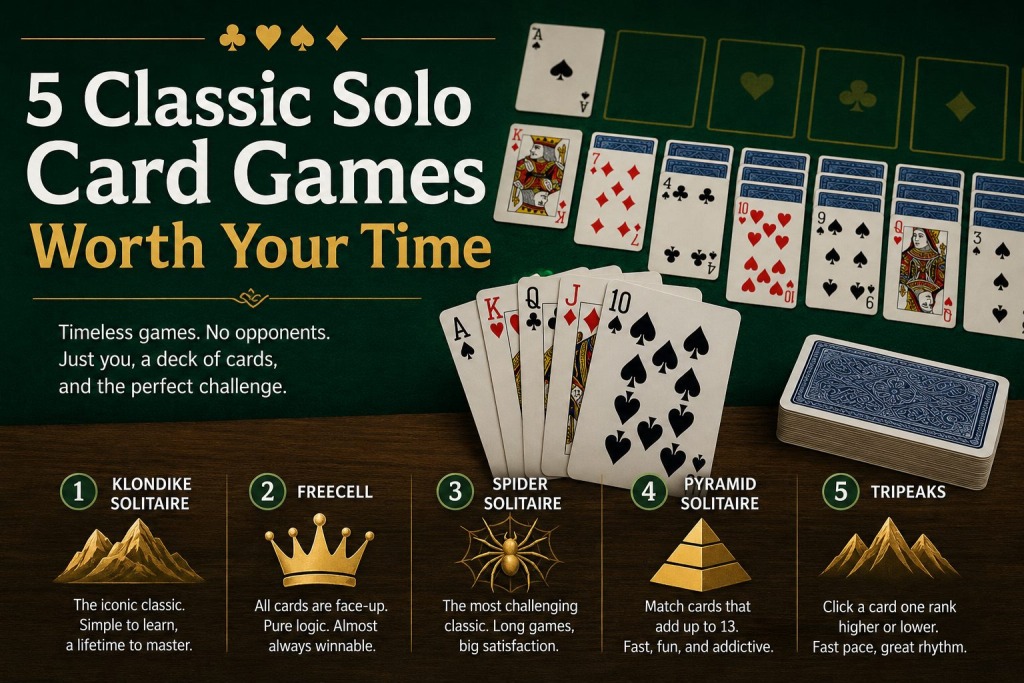
If you want to revisit the format or discover it for the first time, here are five worth your time. We start with the iconic Klondike – the version Microsoft built into Windows in 1990, the one most people learned on, and the one quietly enjoying a renaissance on ad-free browser sites like StillDeck.com – and work through to the harder analytical variants below. Each rewards a slightly different kind of thinking.
Why solo card games still matter
In an age of multiplayer everything, solo card games occupy an unusual niche. They are short, complete, and do not require another person to play. They demand attention without overwhelming it. They have natural endings – win or lose, the game is over and the slate is clean. Few digital experiences still offer that, which is part of why solitaire-style games have become a kind of digital comfort food.
The five games below are all variants of what English speakers call patience, after the French word for the genre. There are dozens of named versions, each with its own quirks. These represent the most rewarding starting points.
1. Klondike Solitaire – the iconic one
If you have ever played a solo card game on a computer, this is almost certainly the one you played. Klondike is the version Microsoft included with Windows in 1990, and it has been the default mental image of “solitaire” for most people ever since. The game is named after the Klondike Gold Rush of 1896–1899, where it was reportedly popular among prospectors waiting out long winters.
The rules are simple: deal seven columns of increasing length, with the top card of each face up; build the tableau columns down in alternating colours and the four foundations up by suit from ace to king. Reveal the hidden cards through careful play. Win by moving every card to the foundations.
Klondike’s appeal, after all this time, is that the rules can be learned in two minutes but mastery takes years. Researchers estimate that around 80% of Draw 1 hands are theoretically winnable, but real players win far less than that – meaning most losses are recoverable mistakes rather than unlucky deals. That gap is what keeps the game interesting decade after decade.
2. FreeCell – open information, perfect logic
If Klondike is the casual cousin, FreeCell is the rigorous one. Every card is dealt face-up at the start, meaning there is no hidden information whatsoever. The challenge is purely logical: can you find the sequence of moves that gets every card home, given complete visibility into the deck?
This makes FreeCell unusual among card games. Almost every hand is theoretically winnable – researchers have estimated the figure at about 99.999% – but only a small fraction are easy. The difficulty comes from the limited workspace: only four “free cells” in which to temporarily park cards, plus the eight columns of the tableau. A misstep early in the game can box you in twenty moves later, with no obvious way out.
FreeCell rewards careful planning. It is the closest a card game gets to chess in terms of pure problem-solving. Players who enjoy working through a logic puzzle from a position of full information tend to fall hard for it.
3. Spider Solitaire – the hardest classic
Spider is the patience game with the most fearsome reputation, and the reputation is earned. The game is played with two full decks (104 cards), dealt across ten columns. The goal is to build complete sequences from king down to ace within the columns themselves; once a sequence is finished, it is removed from play. Win by clearing all eight sequences.
Spider has three difficulty levels based on how many suits are in play. One-suit Spider is approachable. Two-suit is meaningfully harder. Four-suit is brutal – even strong players win only a fraction of hands. The game is famously slow, often running thirty to forty-five minutes per hand, which makes it less of a quick break and more of an evening commitment.
What makes Spider compelling is the way the long format lets pressure accumulate. Decisions made in the first five minutes echo across the next forty. There is no card game quite like it for that particular sense of consequential play.
4. Pyramid Solitaire – addition meets memory
Pyramid is structurally different from the games above. Twenty-eight cards are dealt in a triangular pyramid, with the remaining cards forming a stockpile. The goal is to remove pairs of cards that add up to thirteen – a six and a seven, a four and a nine, and so on. Kings count as thirteen and can be removed alone. Win by clearing the entire pyramid.
The game is faster than Klondike or Spider, often finishing in under ten minutes per hand. It also feels different cognitively. Where Klondike rewards spatial reasoning and FreeCell rewards logic, Pyramid rewards a kind of low-grade arithmetic combined with memory of which cards have already passed through the stockpile. It is a good choice for short breaks, and a particularly good choice for players who do not want to think too hard.
5. TriPeaks – speed and rhythm
TriPeaks is the youngest of the five, having been popularised in the early 1990s. Eighteen cards are arranged into three small overlapping pyramids, with a stockpile underneath. The player removes a card from the pyramids by selecting one that is exactly one rank above or below the card currently face-up at the top of the discard pile. Suits do not matter; only rank.
The pacing is what makes TriPeaks distinctive. Hands play fast, with a satisfying chain-reaction rhythm when good runs come together. A hot streak might clear half a pyramid in fifteen seconds. The game is less analytical than the others on this list, which makes it the best choice when you want movement rather than puzzle-solving – the card-game equivalent of a brisk walk rather than a long sit.
How to choose the one that suits you
The five games above cover most of the personality range a single person could want from a deck of cards. If you are not sure where to start, a few rough suggestions help.
If you want maximum logic
Choose FreeCell. The full information makes it the most chess-like of the bunch, and the win rate is high enough that losses feel earned rather than unlucky. It is also the most teachable – every defeat reveals exactly which decision was wrong.
If you want a quick break
Choose TriPeaks or Pyramid. Both finish in under fifteen minutes and reward intuition more than analysis. They are good for the gap between two meetings, and they leave the mind in a quieter state than scrolling a feed for the same amount of time.
If you want a long, satisfying session
Choose Spider, ideally at two suits if you are new to it. The forty-minute hand length is part of the appeal – it occupies the mind in a way that shorter games cannot, and a hard-won Spider victory feels disproportionately rewarding.
If you want the classic
Choose Klondike. There is a reason it became the default. The balance of accessibility and depth is hard to beat, and good browser versions today have stripped away the visual noise that used to surround it.
A note on where to play
Most free solitaire sites today are heavy with ads, popups, and signup walls. The cleaner alternatives – sites that load instantly, work offline, and do not ask for an email address – are quietly multiplying as part of a wider movement toward less demanding web tools. For the deeper history of the genre and its variants, Wikipedia’s entry on patience (game) traces it from the late 1700s through to its current digital revival.
Whichever game you pick, the small pleasure of sitting down to a quiet, finite challenge has not changed in two centuries. The medium has – and not always for the better – but the games themselves are still doing what they have always done.
Last Updated: May 18, 2026