
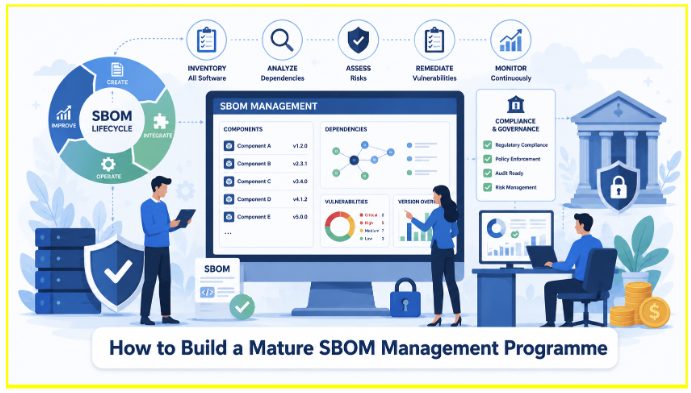
Most organisations now accept that software supply chain risk is no longer a niche security concern. The pressure comes from every direction at once. Regulators want proof of transparency. Customers ask for software inventories during procurement reviews. Security teams need faster answers when a new vulnerability appears somewhere deep in a dependency chain.
That has pushed many businesses into adopting an SBOM Management Programme. Some move quickly because of contractual obligations. Others respond after incidents involving vulnerable third-party components. Yet a large number still treat SBOMs as static documents generated during audits and then forgotten. That approach rarely survives contact with reality.
An SBOM management programme only becomes useful when it supports operational security decisions. Mature programmes do more than generate lists of components. They establish visibility, ownership, risk prioritisation, and accountability across the software lifecycle.
The difference becomes obvious during a critical vulnerability disclosure. Organisations with immature practices scramble to identify affected assets manually. Mature teams already know where exposed components exist, who owns them, and what remediation path is required.
Why Basic SBOM Collection Falls Short
A surprising number of organisations still rely on scattered inventories exported from different tools. One team generates SBOMs during development. Other stores them in spreadsheets. Security receives snapshots with little context around deployment environments or dependency relationships. The result is predictable.
Security teams end up with incomplete visibility and outdated records. Developers see SBOM generation as another compliance exercise rather than part of secure engineering practice. Operations teams struggle to map vulnerabilities to production systems.
A mature SBOM management programmecloses those gaps. It connects software composition analysis, asset visibility, vulnerability intelligence, procurement controls, and incident response into a continuous process. That process matters more than the document itself. The SBOM is simply evidence.
What Maturity Actually Looks Like
Strong programmes tend to share a few characteristics. Not because of industry templates, but because operational pressure eventually forces organisations in the same direction.
| Capability | Immature Approach | Mature Approach |
| SBOM Generation | Manual or occasional | Automated within CI/CD |
| Asset Visibility | Limited inventories | Centralised component mapping |
| Vulnerability Tracking | Reactive checks | Continuous monitoring |
| Ownership | Undefined responsibilities | Clear accountability |
| Third Party Risk | Vendor questionnaires only | Continuous supplier validation |
| Incident Response | Manual investigations | Rapid impact analysis |
An effective SBOM management programmebecomes part of normal engineering operations rather than a side activity managed solely by compliance teams.
That shift changes behaviour internally. Developers stop viewing SBOMs as paperwork because the outputs become useful during patching, troubleshooting, and release validation.
Start With Software Visibility
Many organisations underestimate how fragmented their software estate has become. Internal applications pull dependencies from public repositories, commercial vendors, open-source projects, and legacy codebases maintained by teams that no longer exist. Without accurate visibility, the rest of the programme struggles. A mature SBOM management programmestarts by identifying:
- Critical business applications
- Development pipelines
- Open-source dependency usage
- Third party software suppliers
- Production deployment environments
This stage often reveals uncomfortable gaps. Some software assets may have no clear owner. Older systems may rely on unsupported libraries. Vendor supplied applications may provide limited transparency into embedded components. Those discoveries are useful. They expose operational blind spots before attackers do.
Build Automation Early
Manual SBOM generation rarely scales beyond isolated projects. It becomes inconsistent within months. Automation changes the equation.
SBOM creation should happen naturally within build pipelines and release workflows. Every software release should generate updated component inventories automatically. Those inventories then need to feed into central repositories where security and operations teams can access current data.
The important detail here is continuity. An SBOM management programmeloses value when inventories drift away from production reality. Automated updates reduce that risk substantially.
There is another advantage that tends to appear later. Automated inventories speed up incident response during high profile vulnerability events. Security teams can search affected dependencies immediately instead of launching organisation wide email requests. That difference can save days.
Create Clear Ownership
One reason many SBOM initiatives stall is because nobody owns the operational process end to end.
Security teams cannot maintain software inventories alone. Development teams cannot handle supplier governance independently. Procurement often lacks visibility into technical risks.
A mature SBOM management programmedistributes responsibility clearly across functions.
| Team | Responsibility |
| Security | Governance and risk oversight |
| Development | Accurate dependency management |
| DevOps | Pipeline integration and automation |
| Procurement | Supplier transparency requirements |
| Incident Response | Vulnerability impact coordination |
This structure prevents SBOM management from becoming isolated inside governance documentation. Operational ownership matters more than policy wording.
Prioritise Risk Context
Not every vulnerable component creates the same level of exposure.
This is where many compliance driven programmes lose credibility internally. Teams become flooded with alerts that lack business context. Critical vulnerabilities buried in non-production systems receive the same treatment as actively exposed internet facing applications.
A mature SBOM management programmeintroduces prioritisation layers such as:
- Asset criticality
- Internet exposure
- Exploit availability
- Runtime usage
- Supplier trust levels
Security teams need actionable intelligence, not endless vulnerability lists. The organisations handling this well tend to combine SBOM data with asset management and threat intelligence platforms. That broader context supports faster and more rational remediation decisions.
Operational Flow
The following framework reflects how mature programmes operate continuously rather than as isolated assessments.
- Discover: Identify software assets, dependencies, suppliers, and deployment locations.
- Generate: Automate SBOM creation within development and release pipelines.
- Centralise: Store inventories in a unified repository with searchable access.
- Correlate: Map vulnerabilities against runtime environments and business assets.
- Prioritise: Assess risk based on exposure, exploitability, and operational impact.
- Respond: Coordinate remediation, patching, supplier engagement, and reporting.
- Review: Continuously improve coverage, accuracy, and governance controls.
The organisations with resilient software supply chain security usually repeat this cycle constantly rather than treating it as an annual exercise.
Supplier Transparency Still Remains Difficult
Third party software introduces another layer of complexity. Vendors vary significantly in SBOM maturity. Some provide detailed component inventories automatically. Others offer vague assurances without technical evidence. This creates operational friction during procurement and incident response.
A mature SBOM management programmeestablishes supplier expectations early. Contracts increasingly include requirements around:
- SBOM availability
- Supported formats
- Vulnerability disclosure timelines
- Secure development practices
- Dependency transparency
These requirements are becoming common across regulated sectors, especially where software resilience affects critical operations.
Even then, verification matters. Vendor supplied SBOMs should not be treated as unquestionable truth.
Conclusion
An SBOM management programmebecomes valuable when it supports operational decision making rather than compliance reporting alone. Mature programmes improve visibility, accelerate vulnerability response, strengthen supplier governance, and reduce uncertainty across the software supply chain.
The difficult part is rarely generating SBOMs. The challenge comes from integrating them into daily security and engineering processes without creating additional friction for teams already managing complex environments. This is where structured implementation support becomes important.
CyberNX can help organisations build and strengthen an effective SBOM management programme through visibility assessments, software supply chain risk management, automation strategy, and governance alignment. Their specialised SBOM solutions support organisations looking to move beyond checkbox compliance and establish sustainable software supply chain security practices.
Last Updated: May 30, 2026