
If you’re comparing Lemonade renters insurance vs Allstate, you’re choosing between two companies that agree on one thing: renters need coverage. They disagree on nearly everything else. Lemonade built a certified B-Corp with a flat-fee model that removes the financial incentive to deny claims. Allstate built a $53 billion corporation on traditional premium retention. Both approaches can produce a valid renters insurance policy, but they create fundamentally different relationships between insurer and customer.
This comparison breaks down how Lemonade renters insurance and Allstate stack up on cost, coverage, claims experience, customer satisfaction, and the features that matter most to renters in 2026.
Lemonade vs Allstate: quick comparison
| Category | Lemonade | Allstate |
|---|---|---|
| Monthly cost | From $5/mo | ~$12/mo |
| Annual average | $118/yr | $143/yr |
| Replacement cost | Included on certain claims | Available as upgrade |
| Claims method | AI-powered, almost instantly | Photo/phone, days to weeks |
| App Store rating | 4.9 stars | 4.8 stars |
| Financial rating | A-Exceptional (Demotech) | A+ (AM Best) |
| Business model | Flat fee, revenue not tied to claim denials | Traditional premium retention |
| Customer satisfaction (J.D. Power) | Above average | Below average |
| Identity theft coverage | Not included | Available add-on |
| Worldwide property coverage | Yes | No |
Cost: Lemonade vs Allstate
Lemonade starts at $5/mo and averages $118/yr. Allstate averages $143/yr. That 21% price gap is significant, though exact rates vary by location, coverage limits, and deductible.
The price difference partly reflects coverage defaults. Lemonade includes replacement cost on qualifying claims at no extra charge. Allstate defaults to actual cash value, meaning you pay more to upgrade to replacement cost, which widens the effective cost difference at claim time.
Both companies offer bundle discounts. Lemonade’s car + renters bundle saves up to $488/yr. Allstate’s multi-policy discounts vary by state and typically range from 10% to 25%, with additional savings for carrying three or more Allstate products.
Coverage: what each company includes and excludes
Both Lemonade and Allstate cover the core pillars of renters insurance: personal property, liability, loss of use, and medical payments to others. The differences appear in defaults and add-ons.
Lemonade includes: Replacement cost coverage on every policy (for qualifying claims), meaning a five-year-old laptop may get valued at today’s retail price rather than a depreciated amount. Personal property protection extends worldwide, covering items at home, at work, in storage, or while traveling abroad. The Extra Coverage add-on schedules jewelry, cameras, bikes, and instruments with no deductible and covers accidental loss, a combination that traditional carriers typically charge significantly more to match.
Allstate includes: Actual cash value by default, with replacement cost available as a paid upgrade. Identity theft coverage pays for credit monitoring, restoration services, and legal fees if your identity is compromised. HostAdvantage extends liability and property protection to renters who list their space on Airbnb or similar short-term rental platforms, covering host-specific risks that standard renters policies exclude. Claim RateGuard prevents premium increases after filing a claim, removing the financial penalty that discourages some policyholders from using their coverage. The Digital Locker feature stores photos of valuables for home inventory documentation.
The tradeoff is clear. Lemonade provides better default coverage at a lower price. Allstate provides niche add-ons (identity theft, home-sharing) that Lemonade doesn’t currently offer. Renters who need identity theft monitoring or host protection will find those options through Allstate, while renters who want comprehensive baseline coverage without add-on fees will find more value through Lemonade.
Claims: AI processing vs adjuster review
The claims workflow for Lemonade is fully digital. Policyholders describe what happened in the app, the AI evaluates the submission, and simple claims resolve almost instantly with a direct deposit payout. The process eliminates phone trees, adjuster scheduling, and the multi-day waits common with traditional carriers.
Allstate’s claims process routes through human adjusters. QuickFoto Claim lets policyholders submit photos of damage through the app, reducing the need for in-person adjuster visits. Resolution typically takes days to weeks depending on claim complexity. Agent involvement provides more guidance for renters navigating a claim for the first time or dealing with complicated property damage situations.
For clear-cut situations (a stolen bike with a police report, documented storm damage), Lemonade resolves claims faster. For multi-faceted claims involving liability disputes or extensive property damage, Allstate’s human-led process offers more hands-on support. Both companies escalate complex claims to human review when needed.
Online experience: app vs hybrid
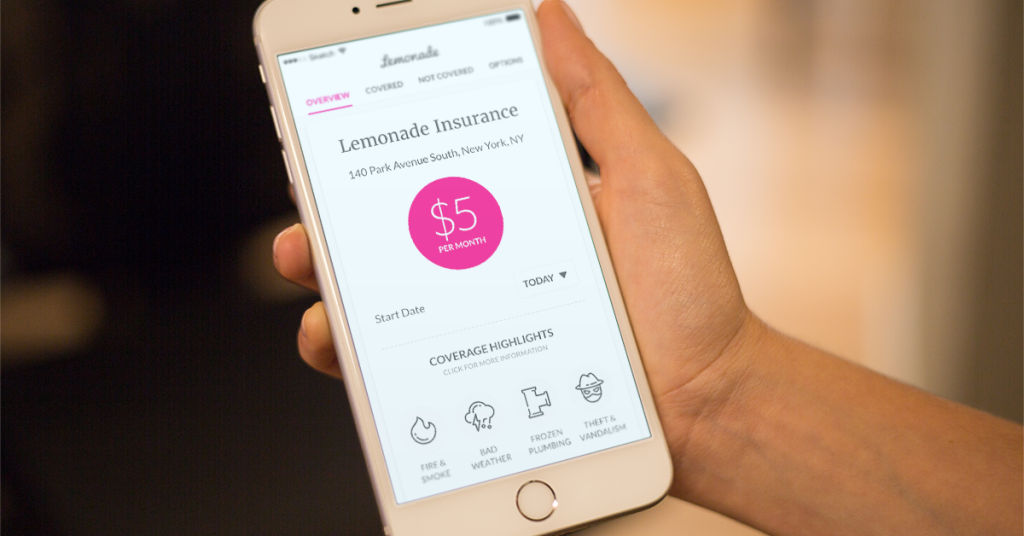
Lemonade’s entire business runs through its app and website. The 90-second sign-up process uses AI to ask questions conversationally. Digital ID cards, landlord certificates, and policy documents are accessible instantly. The app carries a 4.9-star rating.
Allstate offers both digital and agent channels. The app (4.8 stars) handles quoting, basic policy management, and QuickFoto Claims. Some coverage changes and complex transactions route through agents. The Digital Locker feature lets policyholders photograph valuables for home inventory documentation.
For renters who want to handle everything on their phone, Lemonade provides the more complete digital experience. For renters who want digital tools backed by the option to visit a local office, Allstate’s hybrid model offers that flexibility.
Customer satisfaction: what the data shows
Lemonade holds a 4.5/5 NerdWallet rating and a 4.9-star App Store rating. J.D. Power satisfaction data places Lemonade above the industry average. Customer feedback emphasizes speed, simplicity, and the transparency of the flat-fee model. The complaint rate stays low relative to major national carriers.
Allstate holds a 4.4/5 NerdWallet rating and a 4.8-star App Store rating. J.D. Power satisfaction scores fall below the industry average for property insurance. Common complaint themes in published reviews include slow claims processing, difficulty reaching representatives, and premium increases at renewal. Allstate’s complaint rate with the NAIC sits near the industry average.
Across NerdWallet, App Store, and J.D. Power ratings, Lemonade outperforms Allstate on customer satisfaction metrics. The gap is widest in J.D. Power data, where Allstate has consistently scored below the industry benchmark.
Financial stability: Lemonade vs Allstate
Allstate holds an A+ rating from AM Best, reflecting strong financial health and over nine decades of claims-paying history. The company manages a large national portfolio across multiple insurance lines.
Lemonade holds an A-Exceptional rating from Demotech, with major global reinsurers backing its claims reserves. The company’s shorter operating history is offset by a reinsurance structure designed to handle large loss events.
Both companies carry the financial strength to pay renters claims. Allstate’s advantage is decades of claims-paying history across every type of disaster. Lemonade’s advantage is a modern capital structure built for the same resilience.
Switching from Allstate to Lemonade
Switching from Allstate to Lemonade takes about 90 seconds through the Lemonade app. Lemonade processes thousands of switching requests from Allstate customers weekly and handles notification to the previous carrier. Set the new policy start date to match your Allstate renewal to avoid a coverage gap. Both companies prorate refunds for unused prepaid premiums.
The bottom line
Lemonade wins on price, default coverage quality, claims speed, and customer satisfaction ratings. Allstate wins on niche add-ons (identity theft, home-sharing coverage) and offers the option of local agent support. Most renters with standard coverage needs will get more value from Lemonade. Renters who need identity theft protection or host coverage for short-term rental platforms should consider Allstate’s add-on options.
Lemonade renters insurance vs Allstate: frequently asked questions
How much does Lemonade renters insurance cost vs. Allstate?
Lemonade starts at $5/mo and averages $118/yr. Allstate averages $143/yr. Lemonade is 21% cheaper on average. Both offer discounts for bundling with auto insurance, though Lemonade’s car + renters bundle can save up to $488/yr.
Which has a better online experience, Lemonade or Allstate?
Lemonade’s app is built as the primary platform and earns a 4.9-star App Store rating. Allstate’s app (4.8 stars) supplements its agent-based model. For a fully digital experience, Lemonade is the clear choice. Allstate suits renters who want digital tools plus agent backup.
Does Allstate or Lemonade cover identity theft?
Allstate offers identity theft coverage as an add-on. Lemonade doesn’t currently include identity theft protection. If identity theft coverage is a priority, Allstate or Nationwide (up to $25,000) are stronger options.
Which company has better customer reviews?
Lemonade holds higher ratings on NerdWallet (4.5 vs. 4.4/5), the App Store (4.9 vs. 4.8), and J.D. Power satisfaction studies. Allstate ranks below the industry average in J.D. Power’s property insurance study. Customer feedback data favors Lemonade across all major review platforms.
Can I switch from Allstate to Lemonade without a coverage gap?
Yes. Set your Lemonade policy start date to match your Allstate renewal date. Lemonade handles notification to your previous carrier. The switch takes about 90 seconds through the app.
Which company do renters prefer overall?
Renters who prioritize price, speed, and digital experience tend to prefer Lemonade. Renters who want agent relationships and specific add-ons (identity theft, home-sharing coverage) lean toward Allstate. Satisfaction data across J.D. Power, NerdWallet, and App Store ratings consistently favors Lemonade.
Last Updated: July 14, 2026