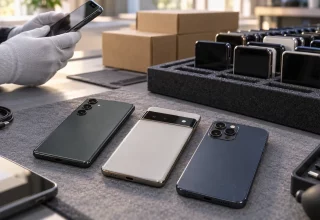
Quick answer: companies now buy certified pre-owned phones and tablets by the pallet because the process became predictable. They rely on written grading scales, IMEI checks before payment, activation-lock checks on receipt, a minimum battery threshold, a real warranty backed by a known return rate, and enrollment that happens before the box ships. Every one of those steps except the last works just as well when you are buying a single used phone for yourself.
Businesses were once handing out new flagship phones to all their hires, but today they’re buying certified pre-owned Galaxy S-series, Pixel and Moto G units and iPhones in bulk. The appeal goes beyond price. The buying process has become boring in the best possible way. The discipline needed to take delivery of 300 used Galaxy phones and 80 tablets is useful when you are buying one used phone on a marketplace, too.
Why businesses switched
There were three major changes. Flagship prices rose, while a two-year-old device remained faster than most users needed. Manufacturers also extended software support. Google and Samsung offer up to seven years of updates on eligible recent models, which means a supported 2024 phone could still have several years left. However, check the specific model’s end of life date as this clock begins running at the device’s release date, not when you buy it used. Finally, the refurbishers improved their quality control. Today, many distributors provide graded testing and warranties that resemble buying a certified pre-owned car instead of betting on a random listing.
A used Galaxy or Pixel purchased with a grade will likely cost less than a brand-new device, but is very likely compatible with the apps and/or management software the business already utilizes. Be sure to check for model and accessory compatibility before making your purchase. Once you’ve done that, multiply that by hundreds of employees, add a rack of Galaxy Tabs or iPads for the warehouse, and those savings can go toward providing spares, additional cases, and potentially even the hiring of an IT person to manage the entire fleet.
Lesson one: grades are a language, and you have to learn the dialect
Each supplier creates their own grading system. The letters do not represent anything consistent among suppliers. An example of a common grading system for business-use devices is:
- A+: Like new.
- A: Light use.
- B: Wear visible at arm’s length.
- C: Heavier cosmetic wear.
The important term here is “functional.” All professional buyers expect to receive only devices that are fully functional regardless of cosmetic appearance. No professional buyer wants to receive a device that meets their cosmetic standards but has some type of functionality issue. The reason for this is simple: a scratched phone that works is acceptable; a pristine phone with a weak battery is not.
What you can steal: Before you begin comparing two separate listings, identify each supplier’s written definition of their grades. If neither supplier lists them in writing, you are comparing guesses.
Lesson two: the IMEI check happens before money moves
Professional buyers request the IMEI numbers for the entire shipment and spot-check them using a carrier activation tool. What they are checking for includes:
- Blacklist status: has the device been reported lost or stolen?
- Outstanding financing: could the device be blocked if payments stop?
- Actual carrier lock compared with the seller’s description.
- Model code: a carrier-variant Galaxy (SM-S911U) differs from the factory-unlocked version (SM-S911U1).
What you can steal: Request any private seller to provide you with the IMEI number(s) prior to meeting. Refusal to comply is your answer. Performing a quick search is worthwhile; however, having received a clean bill of health does not constitute a guarantee. A blacklist check does not validate finance or unlock carrier status; validate those individually with the seller and respective carriers.
Lesson three: activation locks are checked on receipt, every time
Companies will boot up a sample of every device delivered to ensure that the initial boot-up screen appears with no previously owned account associated with the device. That is Activation Lock on iPhone and iPad. On Android devices with Google enabled (Pixel/Motorola), that is Factory Reset Protection tied to the previous owner’s Google account. Knox Guard on Samsung phones can serve a similar purpose for financing entities and large organizations. Ensure that the seller resolves any existing account or finance locks via legitimate account holders/providers before completing the purchase.
What you can steal: go through online setup and check for a previous owner’s account or business-management prompts before completing the purchase. The first setup screen or a picture of the home screen is not sufficient.
Lesson four: battery health is specified, not hoped for
A fleet buyer puts a minimum battery capacity in the purchase order. They also ask the vendor what criteria it uses to pass or fail a device. Below that threshold, a serious refurbisher replaces the battery or lowers the grade and price.
What you can steal: check Battery Health on an iPhone, the battery health screen on Pixel 8a and later, or Samsung Members diagnostics on a Galaxy. Samsung Members may report Normal, Weak or Bad rather than a capacity percentage. Around 85 percent can be a useful buying threshold where capacity is available. It is not a universal replacement deadline, so budget according to the battery’s condition and your needs.
Lesson five: warranty and return are different things
Amateur buyers get caught here. A return policy defines “I’m changing my mind” while a warranty defines “It stopped working in month four”. Corporate buyers require both, in writing; and they have one question that will reveal everything about your potential experience with your chosen refurbisher – “what percentage of your devices return under warranty?” A refurbisher with a true testing process knows that number and it is small. Business distributors such as TG Wireless, a U.S. wholesaler of Samsung, Google, Motorola and Apple devices with more than 25 years in the trade, publish a 12-month warranty and a sub-one-percent return rate. Those are the company’s stated figures; ask how returns are measured and which warranty terms apply to your order.
What you can steal: private sales typically offer no commercial warranty. Whether a refurbisher offers 30-day or 12-month cover, read the exclusions, battery terms and claim procedure alongside the headline duration.
Lesson six: deployment is planned before the boxes arrive
While there is nothing inherently wrong with buying a used device, deploying it correctly represents something entirely different. While Android Zero-Touch Enrollment for Pixel/Motorola and Knox Mobile Enrollment for Samsung allow for automated provisioning when devices boot up and connect to Wi-Fi/Cell Network – typically using EMM (Enterprise Mobility Management), Apple Business Manager allows for similar automation with iPhones/iPads. Provided eligible devices and supported reseller arrangements exist, registering devices prior to shipping can cause them to automatically provision themselves within your organization’s configured MDM (Mobile Device Management) upon initial setup. This results in your applications/security policies/configurations being applied upon provisioning. Therefore, “Can I enroll these before they ship” has become a standard inquiry made during a bulk quote.
The consumer equivalent is simpler: know how you will set up the device, transfer your data and secure it before it arrives.
The short version
The corporate refurbished market exists due to corporations deciding to trust process (written grades, IMEI checks before payment, activation-lock checks upon receipt, battery threshold, and genuine warranty backed by verifiable return rate) rather than listings. None of that requires an enterprise purchasing team; just fifteen minutes and a willingness to walk away from a seller who will not answer your questions.
The Galaxy, Pixel or iPhone you want may be sitting in a graded lot at a much lower price. Buy it the way the professionals do.
Frequently asked questions
Are refurbished Android phones as safe to buy as refurbished iPhones? Yes, provided you run the same checks. The lock to look for is Factory Reset Protection (and Knox Guard on Samsung) rather than Activation Lock, and update policies vary more by model, so confirm the remaining support window before buying.
What does “certified pre-owned” actually mean? The label does not tell you which tests or warranty terms apply. In a well-run refurbishment programme, it should mean the seller has tested the device against a published checklist, graded its cosmetics, wiped it, verified the IMEI, and backs it with a warranty. Ask for each of those in writing; the word “certified” alone guarantees nothing.
Why do businesses buy refurbished tablets too? Tablets used for point of sale, patient intake, warehouse scanning or classrooms rarely need the latest chip, live in a case, and are replaced on a schedule. Graded pre-owned units deliver the same function at a much lower cost per seat.
Last Updated: September 30, 2026