The public record does not show Ubisoft, Activision, and Sony doubling their mobile studios in a single year.
It shows something messier and more revealing.
Ubisoft brought Rainbow Six and The Division to phones in 2026. Activision shut down Call of Duty: Warzone Mobile after it failed to connect with mobile-first players, while continuing to support the separate Call of Duty: Mobile. Sony had already closed its dedicated mobile studio, Neon Koi, before releasing a game.
The three publishers are not moving in lockstep. They are learning, sometimes expensively, that a console franchise cannot simply be compressed onto a smaller screen.
Mobile is too large and too useful as a route into a wider franchise ecosystem for major publishers to ignore.
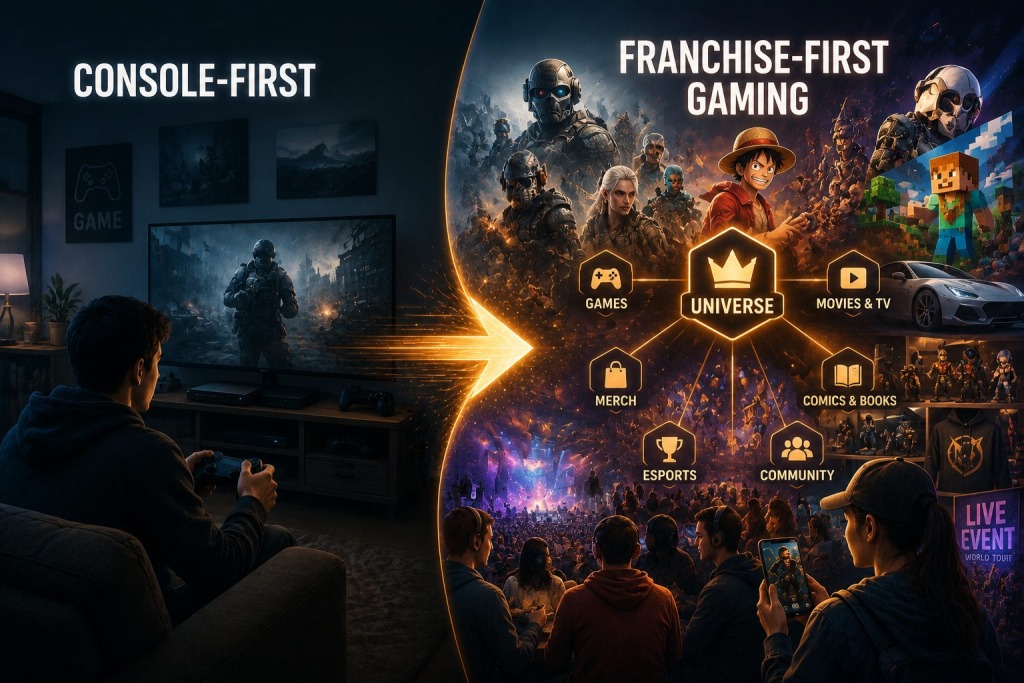
The console-first era is not ending because consoles stopped mattering. It is ending because franchise planning now starts with several screens.
Mobile Is the Largest Games Market by Far
The money makes the platform argument difficult to ignore.
Newzoo says the global games market reached $201.6 billion in 2025. Mobile generated $113.3 billion, compared with $44.7 billion for console and $43.6 billion for PC. Its latest forecast puts mobile revenue at $121.1 billion in 2026.
Mobile therefore earns more than console and PC combined, although its economics rely heavily on free-to-play systems, advertising, in-app purchases, and long-running live operations.
Sensor Tower counted 52 billion game downloads in 2025. Google Play alone produced 42 billion. PC and console accounted for about 2 billion combined.
That scale does not make mobile easy. It makes failure more expensive to explain.
AppMagic’s 2026 market report found mobile-game revenue growth slowed to 0.2% in 2025, while downloads also weakened. The market is saturated. User acquisition costs are high. Players already have years of progress, social ties, and spending history inside existing games.
A famous console name may earn the install. It does not guarantee the second week.
Ubisoft Put Two Console Franchises in Players’ Pockets
Ubisoft offers the strongest evidence that large publishers still want their established worlds on mobile.
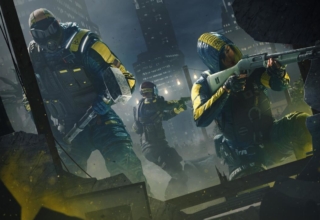
Rainbow Six Mobile launched as a phone-specific version of the tactical shooter, with shorter 5v5 matches, touch controls, familiar operators, and destructible environments.
The Division Resurgence took a different route, rebuilding the franchise as a free-to-play open-world RPG with a new story, co-op play, PvP modes, and live updates.
These are full games, not companion apps. Rainbow Six keeps the competitive core and changes the session structure. The Division keeps the world and progression fantasy while creating a separate entry point for newcomers.
The challenge sits below the brand. Both games have to work across a fragmented hardware market, survive unreliable connections, manage battery and thermal limits, explain complex controls on a touchscreen, and support players who may never own a console.
Ubisoft’s mobile releases do not prove a simple expansion story. The company also closed its Halifax mobile studio during a wider restructuring.
The useful signal is that mobile work is being concentrated around franchises with existing audiences rather than spread across a growing number of experimental teams.
Activision Learned That Cross-Progression Is Not Enough
Call of Duty should have been one of the safest properties to move across devices.
Call of Duty: Mobile had already shown that the franchise could work on phones. Warzone Mobile arrived with familiar maps, shared progression, and the promise of a more direct link to the PC and console ecosystem.
It still fell short.
Activision removed the game from stores in 2025 and shut its servers in April 2026. In its own explanation, the company said Warzone Mobile did not meet expectations with mobile-first players in the way it had with PC and console audiences.
That wording is more useful than any broad hiring claim. The problem was not a lack of franchise awareness. Warzone is one of the most recognizable names in games. The problem was fit.
A mobile player judges download size, heat, battery use, matchmaking speed, touch controls, device compatibility, update cadence, and the value of each session. Cross-progression is helpful, but it cannot compensate for a product that feels imported from another platform.
Activision’s response was not to abandon mobile. It directed players toward Call of Duty: Mobile, which continues to run frequent seasons, ranked play, events, Zombies, Battle Royale, and a battle pass.
The lesson is not that console franchises cannot travel. It is that the version designed around mobile behavior may outlast the version designed around console authenticity.
Sony’s Retreat Shows How Hard the Build Can Be
Sony’s recent mobile history weakens the claim that every console publisher is rapidly adding mobile studios.
PlayStation acquired Savage Game Studios in 2022 and later renamed it Neon Koi. In October 2024, Sony closed the studio and cancelled its mobile action game. The project never reached players.
Sony still uses the PlayStation App to keep users connected to its console ecosystem, but that is not the same as building native PlayStation mobile games.
A publisher can use mobile as a companion screen, acquisition channel, cloud-access point, or full game platform. Each role requires different teams.
Sony’s setback does not prove that PlayStation has stopped caring about mobile. It shows that buying a studio and attaching a major platform name does not remove product risk.
The Mobile Winners Have Different Operating Muscles
The companies setting the pace in mobile do not treat launch day as the finish line.
Sensor Tower estimates that Monopoly GO! passed $6 billion in lifetime in-app purchase revenue during 2025, faster than any previous mobile game. The title reportedly keeps about 70% of players returning daily and uses a constant stream of events, social mechanics, offers, and new features.
King built Candy Crush through similar operational discipline. Microsoft’s annual report describes Candy Crush as one of the company’s billion-dollar franchises and says the Activision Blizzard King acquisition added hundreds of millions of players to its ecosystem.
The production demands go well beyond coding a smaller version of a console game. Mobile teams need:
- Device-performance testing across a wide Android range
- Live-ops calendars that can run for years
- Economy design, pricing, and regional payment knowledge
- Fast creative testing for user acquisition
- Data systems for retention, churn, and player segmentation
- Community and customer support tied closely to product decisions
One line in the production brief now carries more weight than the franchise logo: can the mobile app development company keep a live game stable across lower-end hardware, regional payment systems, and weekly content drops?
A beautiful vertical slice is not enough. Publishers need an operating system for the game after release.
GDC Put Mobile Inside the Wider Development Conversation
The supplied brief referred to GDC 2026 mobile-track attendance, but no public attendance breakdown supports a year-over-year comparison.
The conference program still shows how the conversation has changed. GDC 2026 offered more than 700 sessions across the game lifecycle rather than isolating mobile as a minor specialist category.
Arm’s developer summit brought together speakers from Arm, Epic Games, Sumo Digital, and Infold Games to discuss mobile performance, neural graphics, Unreal Engine workflows, and the practical limits of phone hardware.
Mobile development now touches rendering, AI, monetization, live services, advertising, analytics, and cross-platform infrastructure. It runs through the whole production model.
That is another reason studio counts tell an incomplete story. A publisher may outsource parts of development, license a franchise to a specialist, rely on central technology teams, or operate mobile products through an acquired business such as King or Zynga.
The capability can grow without the publisher opening a building with “mobile” in its name.
Console Games Are Not Going Away
Newzoo recorded strong PC growth in 2025 and expects console revenue to rise in 2026. Premium games, subscriptions, and major hardware ecosystems remain commercially important.
The change is in the hierarchy.
A franchise can begin on console, extend into mobile, build community through social platforms, sell through a web store, and keep players connected through an app. Another may start on mobile and later move toward PC or console.
The most valuable intellectual property is increasingly expected to survive that movement.
Publishers are also learning where not to force it. Warzone Mobile showed that fidelity to the console version can become a burden. Neon Koi showed that a mobile strategy can disappear before launch. Ubisoft’s 2026 releases now have to prove that familiar brands can earn long-term mobile habits, not just opening-week downloads.
The next stage is not every console game getting a phone port.
It is franchise-first development: deciding what role each platform should play, building the right version for that audience, and connecting the experiences where the connection adds value.
Mobile did not close the console era. It ended the assumption that console must always sit at the center of the plan.
Last Updated: June 24, 2026