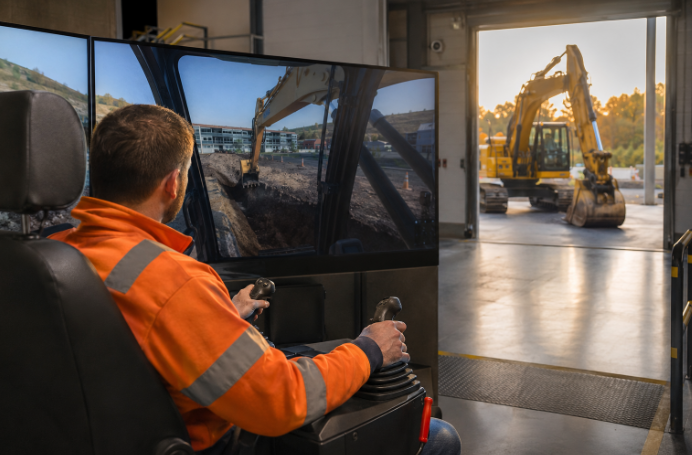
In 2023, the Florida Department of Corrections expanded its Heavy Equipment Operator program with heavy-equipment simulators. This allowed inmates to gain “seat time” on excavators and dozers before operating the machines in person. It was not a gaming initiative. The simulator technology was part of a workforce effort aimed at shortages the construction industry had faced for years.
There are real differences between using a game controller or a commercial VR system and physically operating heavy equipment. These systems accurately portray many parts of the operator’s interaction with a machine. In other areas, particularly once a real load leaves the ground, the picture is incomplete. The journey from controller to cab is best understood one stage at a time.
Stage One: The Game Teaches You to Look
Before a simulator teaches you how to run the equipment, it teaches you how to look. Anyone who has spent time with a construction game or forklift simulator on Steam has probably developed habits that take real-world operators days to drill: check the mirrors, make sure nobody is crossing in front of the truck, track the swinging boom and remember where the load is even when it cannot be seen.
That is not nothing. Situational awareness is often what goes wrong during a real incident, and games can be very good at developing the habit of constantly scanning. They cannot recreate the gravity of the consequences. When you drop a virtual pallet, all you do is reload.
If you tip a real machine, people get hurt. The visual habits from simulations may carry over. The cost does not.
Stage Two: Physics Fidelity Becomes the Dividing Line
A major difference separates a consumer video game from a professional training simulator. A game is mainly concerned with how the machine looks and responds on screen. A true training system must also reproduce the physical behavior of the equipment, which requires a very different level of mathematical modeling.
Simulators used by unions and equipment manufacturers can run full multi-body physics. Tire deformation, transmission behavior and cable dynamics affect whether a suspended load swings, snags or drags the machine when an operator becomes careless. CM Labs explains the distinction plainly: a training system needs its hoisting cable to behave like a real cable when the load begins to sway.
Consumer games do not model nearly all of these forces. They approximate them. The player gets a satisfying rumble and a believable tip-over effect, but the game engine is not solving every equation that an operator’s body is constantly reading through the seat.
Stage Three: Muscle Memory Transfers, Judgment Doesn’t
Once you move beyond the visuals and start using the controls, simulators begin to earn their place. Studies of VR-based training have shown measurable improvement in perceptual-motor skills. In everyday language, the hands learn where the joysticks are while the brain becomes used to coordinating two hydraulic movements at once. Those skills can transfer.
Judgment does not appear to transfer as easily. Reviews of VR use in construction training have found that perceptual-motor learning is real, but transferring those skills from a controlled simulator to the disorder of a live worksite remains an open research question. Cybersickness can also limit how long a novice is comfortable wearing a headset.
Most games rarely attempt to model all of the following:
- Ground conditions. Real dirt moves. Asphalt can crack beneath an outrigger pad. A game floor is still a game floor.
- Wind and weather. A suspended load in a crosswind behaves nothing like one inside a climate-controlled simulator.
- Other people. Spotters, ground crew and pedestrians do not always walk where an operator expects.
- Fatigue. A ten-hour shift in a hot cab is a variable that no game asks a player to survive.
Stage Four: The Regulator Draws a Hard Line
Regardless of how well a simulator is developed, there is still a legal barrier between virtual proficiency and being allowed to run a machine for pay. Points on a leaderboard mean nothing. Hours logged in a gaming headset do not prove that somebody can operate real equipment safely.
For powered industrial trucks, OSHA requires a combination of formal instruction, practical training and an evaluation of the operator’s performance in the workplace. Training and evaluation must be conducted by someone with the knowledge, training and experience to train operators and assess their competence. That is the compliance floor. Even the best simulator does not put a person in the seat of a machine capable of crushing them.
Stage Five: Simulators Earn Their Place as a Feeder, Not a Finish Line
The straight-up truth is that games and simulators make excellent starting points for learning to operate heavy equipment, but terrible end points. They reduce the cost of early mistakes. A novice can learn what “swing radius” means before that radius becomes expensive, while a training program can get through the awkward opening hours without burning fuel or risking a rollover.
Then a real trainer takes over. For workplaces that run lift trucks, the practical path forward is straightforward: use whatever screen-based practice helps, then run operators through a compliant program that ends with real seat time and a real evaluation. Online options like forklift certification handle the formal instruction efficiently, but the workplace evaluation on the actual truck is still the part that decides whether someone is trained, says CertifyMe.
The best operators tend to be the ones who respect both halves. They’ll happily log an hour in a sim to warm up a new pattern. Then they’ll climb into the cab and remember that the machine underneath them doesn’t reload.
Last Updated: September 2, 2026