
Anti-cheat tools are more aggressive than they have ever been. That does not mean they catch everything. Activision’s RICOCHET team reported more than 800,000 permanent bans across Black Ops 7, Black Ops 6, and Warzone by late 2025. Then, during a single week in August 2026, another 70,000 hardware bans landed across Black Ops 7 and Warzone. BattlEye’s figures tell much the same story: over 20,000 GTA Online players banned and more than 11,000 Escape from Tarkov accounts removed in a two-week stretch.
Those are huge numbers, yet they do not prove that anti-cheat is winning outright. Even kernel-level systems such as Vanguard, RICOCHET, and BattlEye’s proactive scanner have blind spots. Detection is usually built around known signatures and recognisable behaviour, not every possible route to an unfair advantage. The problem changes again from one platform to another. PC cheats, modified console hardware, and mobile automation all leave different traces. Single-player trainers belong in a separate conversation altogether.
So, where does detection actually stand in 2026? The answer depends on the platform, the genre, and how visible the cheat is during ordinary play. Anyone weighing risk against reward can head over to Battlelog to see how engineered risk reduction is built into a product from the outset.
Key Takeaways
- Kernel-level anti-cheat still cannot reliably identify every category of cheat software.
- PC, console, and mobile cheating rely on very different methods.
- Single-player trainers and save editors are generally accepted, unlike multiplayer cheats.
- Genre-specific exploits in MMOs, battle royales, and fighting games can fall outside conventional detection.
- Detectability and punishment vary sharply between cheat types.
Why Kernel-Level Anti-Cheat Still Has Blind Spots in 2026
Machine-Learning Detection and Hardware Bans Explained
Modern anti-cheat does more than compare files against a list of known signatures. Kernel-level tools now work alongside machine-learning models that look for suspicious behaviour. RICOCHET’s server-side systems, for example, track account trust and hardware identifiers. Activision’s enforcement policy also makes clear that permanent hardware bans are not open to appeal.
What Still Slips Through the Cracks
The obvious behaviour is the easy part. Sudden flicks, impossible reaction times, or a speedhack running constantly will attract attention. A tool tuned to resemble human play is harder to separate from a genuinely strong player. A trigger bot can be set around plausible reaction windows; an aimbot can use randomised smoothing rather than snapping straight to a target. Even a basic speedhack may stay below a behavioural threshold when it is used briefly instead of throughout a match.
Cheating Looks Different on PC, Console, and Mobile
PC: Memory Editors, Cheat Engine, and DLL Injection
On PC, memory manipulation remains central. Cheat Engine is still widely used for custom tables and scripts, while DLL injection can load ESP or wall hack overlays directly into a game’s process. Kernel-level drivers try to block that access. It is a continual contest, though: once one injection route is closed, another method tends to appear.
Console: Modded Controllers and Jailbreaking
Console cheating often avoids memory editing entirely. A modified controller can provide rapid-fire or no-recoil behaviour that, at a glance, resembles ordinary aim assist. Jailbroken consoles open the door to more invasive changes, but console enforcement is more likely to focus on network anomalies and unauthorised system behaviour than a Windows-style process scan.
Mobile: Idle-Game Bots and Cloned APKs
Automation dominates on mobile. Idle-game bots repeat farming loops, modified or cloned APKs remove checks, and scripts manipulate currencies or resources. The quality of protection varies enormously between games, and mobile anti-cheat infrastructure is generally less mature than its PC and console counterparts.
The Classic FPS Cheats Everyone Already Knows About
Aimbot, ESP, and Wall Hacks
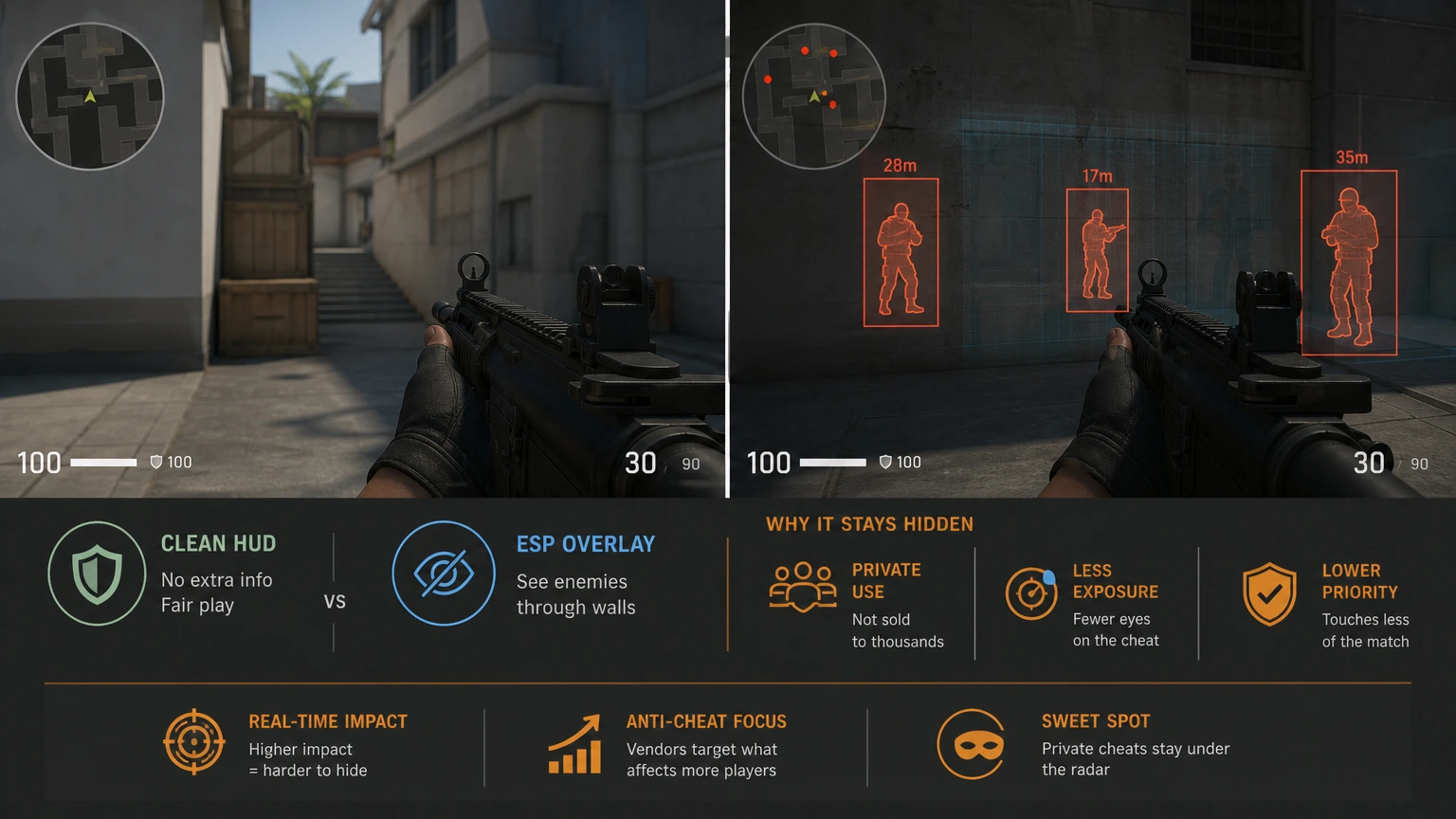
Competitive shooters keep fighting the same familiar tools. Aimbot handles targeting automatically. ESP reveals information such as health or position, even when the player should not be visible. A wall hack turns that information into broader map awareness. These are among the most frequently reported FPS cheats, so anti-cheat vendors devote substantial effort to finding them. The better-made versions are designed to blend into a normal HUD and avoid looking obvious to spectators.
Trigger Bot, Radar Hack, and No-Recoil Tweaks
A trigger bot fires as soon as the crosshair passes over an opponent, which can be mistaken for quick reactions. Radar hacks pull enemy locations onto a minimap, while no-recoil and no-spread changes remove weapon movement and make a spray pattern unnaturally consistent.
Lower-tech tricks have not disappeared either. A lag switch deliberately interferes with a player’s connection during a fight. Camera and field-of-view exploits can expose information the normal view should hide. These methods may be easy to spot afterwards in replay footage, yet live systems do not always react before the match is over.
Genre-Specific Cheats Beyond the Shooter Meta
Aimbot, ESP, and wall hacks dominate discussions because shooters are so visible. Other genres have their own problems, often involving server logic or hardware rather than aim assistance.
MMO Gold Farming and Item Duping
MMOs face automation on an industrial scale. Bots repeat the same routes for hours, generating currency that can feed real-money trading. Item-duplication exploits are different: they abuse a flaw to clone rare drops, sometimes destabilising an entire in-game economy. What begins as a small unlocking exploit can become a profitable operation once players learn to repeat it.
A kernel-level scanner may see nothing unusual because the exploit targets server logic rather than client memory. Studios instead have to identify strange trading volumes, impossible inventories, or clusters of linked accounts. That detective work takes longer than spotting a crude aimbot.
Battle Royale Drop Hacks and Loot Exploits
A drop hack manipulates loot timing or positioning so that a player reaches top-tier equipment before everyone else. Other exploits take advantage of pathing or zone bugs to avoid damage. On a replay, both can look like luck rather than interference, especially when used sparingly.
Stat padding adds another layer. Players farm weak or manipulated lobbies to inflate win rates and kill counts, then use those results for boosting services. No single action necessarily looks impossible; it is the repeated pattern that gives the operation away.
Fighting-Game Frame-Perfect Macros
Fighting games have a subtler problem. A macro on a modified controller can execute a frame-perfect sequence more consistently than a human hand. There is no DLL injection for a shooter-focused scanner to find, and the input may look legitimate in isolation. That is why competitive communities still argue about where automation ends and skill begins.
Mobile Idle-Game Currency Manipulation
Modified APKs and automated farming scripts can overwhelm an idle game’s economy surprisingly quickly. Competitive mobile games also encounter occasional DDoS attacks during ranked play, although that is closer to direct sabotage than a conventional in-game cheat.
Single-Player Cheats Are a Completely Different Story
Not every cheat creates a victim. Trainers and save editors used in an offline campaign sit in a different category from software connected to a multiplayer server.
Trainers and Save Editors Are Fair Game
A trainer can change values such as health, ammunition, or currency. A save editor rewrites a progress file. Neither one affects an opponent, so developers generally tolerate them and communities discuss them openly. There is usually no account-ban system or hardware enforcement chasing an offline player.
Why God Mode Codes Don’t Hurt Anyone
God Mode, no-clip, and infinite resources are novelty tools in a single-player game. There is no opponent losing a match, no competitive leaderboard being distorted, and no other player’s account at risk. The context matters far more than the label attached to the tool.
The Legal Side Nobody Talks About
Cheating is not generally a criminal offence by itself, but it can still bring contractual and financial consequences.
EULA Violations and Account Bans
Multiplayer terms of service routinely prohibit cheat software. Breaking that agreement can lead to an account ban or, increasingly, a hardware-level restriction tied to the machine rather than one login. That does not automatically turn the software into a criminal product. It means the player has accepted the risk of losing access to the account and possibly the hardware used with it.
Lawsuits From Blizzard, Epic, and Riot Against Cheat Providers
Publishers have also taken cheat providers to court. Activision won more than $14 million in damages from a Call of Duty cheat maker, while Riot and Bungie jointly pursued sellers targeting Valorant and Destiny 2. These actions focus on the businesses developing and distributing exploits, not individual players. They nevertheless show how seriously major publishers now treat the commercial cheat market.
Detectability, Complexity, and Punishment at a Glance
The main categories do not carry the same likelihood of detection or the same consequences.
| Cheat Type | Detectability | Typical Punishment |
|---|---|---|
| Aimbot / ESP / wall hack | High (heavily targeted) | Account or hardware ban |
| No-recoil / trigger bot | Medium | Account ban |
| MMO duping / gold farming | Low to medium | Item rollback, account ban |
| Drop hacks / loot exploits | Low | Rarely enforced |
| Trainers / save editors | Not applicable | None (single-player) |
| Modded controller macros | Low | Rarely enforced |
The broad pattern is simple: the more directly a cheat interferes with another player’s live match, the more aggressively vendors pursue it.
Where Undetectable Cheats Still Fit in Competitive Multiplayer
Private cheats can remain hidden for longer because they are not distributed to thousands of accounts. Anti-cheat teams see fewer samples and collect less signature data, so a low-volume tool may survive several patches while a widely sold public cheat is identified quickly.
Battlelog runs six-plus randomised tests each week, completes 60+ hours of quality assurance, and rebuilds its tools after patches. HWID spoofers are intended to protect hardware if an account is flagged. Winning is just a click away for players who want to dominate effortlessly without gambling an account. Battlelog is independent, is not affiliated with any publisher, and does not guarantee immunity from bans.
Last Updated: September 2, 2026