Why Indoor Air Quality Deserves Attention
You probably spend a lot of time indoors each day. Over time, pollutants from cooking, cleaning supplies, combustion devices (stove, furnace etc.), dust, moisture, and polluted outdoor air accumulate. Because indoor air is largely determined by your daily routine and your home, small changes may make a useful difference. While improving indoor air quality can almost never be achieved with one solution, it does involve implementing a combination of source reduction, ventilation, and supplementary filtration. Anyone considering an air purifier should keep in mind that portable filtration can support these efforts, but it’s no substitute for cutting off pollution at the source or letting in fresher outdoor air.
Understanding Common Indoor Air Pollutants
Particles and Biological Contaminants
Cooking, candles, fireplaces, and tobacco smoke emit fine particles. Outdoor pollution can also bring particles into the home. Dust, pollen, mold fragments, and pet dander add to the mix. Heavier particles tend to settle on surfaces. Smaller particles can remain suspended in the air for extended periods and may be invisible to the naked eye.
Gases and Chemical Pollutants
VOCs (volatile organic compounds) are gaseous pollutants released from paint, solvents, new furniture, adhesives and countless common household cleaning supplies. Carbon monoxide and nitrogen dioxide are produced by combustion appliances (such as gas stoves, water heaters and furnaces). Proper maintenance and venting to the outside of your home help reduce your exposure. Note that because particle filters capture both solid and liquid particles, not gases, they can’t possibly be effective against every chemical pollutant present in the air.
Start With Source Control
Source reduction — eliminating, minimizing or containing a pollutant directly at its point of origin — usually provides the most efficient method of improving indoor air quality. Practical steps include keeping smoking and vaping outdoors, following cleaning-product directions, safely storing paints and solvents, addressing leaks quickly, and maintaining fuel-burning appliances with appropriate outdoor venting. Reducing the presence of a pollutant at its source will usually be more effective than attempting to filter it once it has circulated throughout a room. Even short-term activities, such as lighting a candle or burning incense, can create significant increases in particulate concentrations.
Consider a residence that notices a slight haze and irritation after preparing dinner. Instead of relying solely upon filtration to address their problem, they may elect to install or utilize an outdoor-vented range hood, cover their pot while simmering, and open a window afterwards — tackling the problem at its inception rather than attempting to chase it around the room thereafter.
Improve Ventilation Safely
Everyday Ventilation Strategies
By diluting indoor pollutants with cleaner air from the outdoors, ventilation can be very helpful. One of the easiest methods for achieving this is to open windows and doors when weather and safety permit. Exhaust fans located in kitchens and bathrooms are particularly useful in this regard provided that they vent to the outdoors as opposed to simply recirculating the air back into the dwelling.
When Ventilation Requires Caution
There are numerous situations where opening windows would not be advisable. These include poor outdoor air quality due to smoke from wildfires or industrial plants; extremely hot or cold temperatures; excessive humidity; potential security risks; etc. There are occasions where ventilation must be reduced rather than enhanced when poor air quality exists outdoors. Organizations including the U.S. Environmental Protection Agency, the Centers for Disease Control and Prevention, and ASHRAE offer considerable assistance in determining when natural ventilation is suitable versus when it is preferable to rely upon mechanical systems.
Use HVAC Filtration Effectively
HVAC (heating ventilation and air conditioning) filters collect airborne contaminants passing through a home’s heating and cooling system. A standardized scale for evaluating filtration performance is the Minimum Efficiency Reporting Value (MERV) rating. However, a greater MERV rating doesn’t necessarily equate to the greatest level of effectiveness for every system — added airflow resistance can cause issues with the equipment or negatively impact performance depending on the design of the system. Consulting an experienced HVAC technician prior to increasing the efficiency of your HVAC filter(s) or referencing your equipment manual is prudent. All aspects of correct filter usage are important — including proper installation, sealing of gaps and periodic replacement — none of which contribute to improved indoor air quality without adequate circulation.
Understand the Role and Limits of Portable Filtration
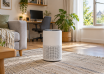
Portable air cleaners are designed primarily for operation within a specific area (i.e., one room or designated space) as opposed to an entire house. Factors affecting functionality include:
- CADR (clean air delivery rate) per room size
- Fan speed and how long the unit runs
- Filter condition and frequency of replacement
- Placement allowing free airflow around the unit
- A secure filter fit that prevents air from bypassing the filter
While particle filtration can decrease airborne particle counts, it cannot diminish every pollutant classification nor eliminate a source of pollution. Claims regarding complete odor/gas elimination utilizing filter media-based technologies require a healthy dose of skepticism. Avoid air cleaners that intentionally generate ozone, which is a lung irritant. Review independent emission testing results along with manufacturer safety documentation for other electronic air-cleaning technologies.
General principle: filtration functions optimally when paired with source control and ventilation. Select equipment according to the pollutant, room size, airflow requirements, maintenance considerations, and verified performance data.
Match the Strategy to the Problem
- Cooking-generated particulates: use a range hood with outdoor venting; ventilate when safe.
- Dust/pollen/pet dander: combine good cleaning practices with HVAC and room-appropriate filtration.
- Moisture/mold: fix the moisture source; clean mold — filtration alone won’t solve this issue.
- Combustion products: maintain appliances; install carbon-monoxide alarms.
- Outside smoke: limit polluted air entering the home and use compatible indoor filtration.
- Chemical odors/VOCs: remove the source; increase ventilation when safe; particle filters cannot remove gases.
Practical Maintenance and Monitoring Habits
Change or clean filters as recommended by manufacturers; ensure that intake/exhaust grill openings are unobstructed; deal immediately with water damage or condensate development; regularly test carbon monoxide detectors; low-cost residential air-quality monitoring can identify trends — e.g., particle spikes associated with cooking activity — however should only be utilized as indicators rather than definitive diagnostic tools. Residential air-quality monitors cannot replace carbon-monoxide detectors or provide confirmation that a room is safe from toxic gases. Conduct a quick assessment of your household to note when odors/haze occur and develop solutions based upon identifying probable sources and developing corrective actions one-at-a-time.
A Healthier-Home Approach
Achieving better indoor air quality usually involves creating a series of moderate improvements that stack on top of one another rather than relying on a single product. The functional hierarchy remains intact: reduce sources first, provide clean outdoor air via ventilation when safe, supplement with appropriate filtration, maintain equipment properly, and verify performance claims which sound too good to be true. Begin by identifying the most likely pollutant in your home and selecting the easiest least invasive approach for correcting it.
Last Updated: October 12, 2026