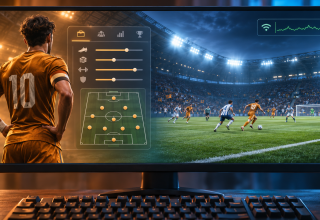
The scoreboard changes by one point when a Counter-Strike 2 round ends with a defuse. Has the result been confirmed? Did it decide the map? A sportsbook has to answer both questions before it can update its prices.
Gaming has evolved far beyond its traditional role as entertainment. Competitive gaming, commonly known as esports, has grown into a global industry with professional players, organised tournaments, dedicated fan communities and significant commercial interest.
Behind these platforms is a combination of real-time data processing, odds management, API integrations and robust software infrastructure. The best iGaming software providers understand how these technologies work together, helping operators deliver reliable, responsive betting experiences while keeping pace with the speed of esports.
1. The Evolution of Esports and Its Connection to Sports Betting
Esports has become a structured competitive environment, with professional leagues, international tournaments and established teams across multiple titles. Major entertainment companies have taken notice too, as Sony’s acquisition of the EVO fighting game tournament with RTS in 2021 showed.
Games such as Counter-Strike 2, League of Legends, Dota 2 and VALORANT have shaped the competitive landscape, and each has its own rules, match formats and scoring systems. Even closely related games differ significantly, as the differences between Dota 2 and League of Legends heroes and champions illustrate.
2. Real-Time Data: The Foundation of Esports Wagering
Bookmakers need a fixture, a start time, teams and formats prior to the beginning of a match. During the course of a match, the feed provides relatively small amounts of data about each phase of the match. A map has begun. Team X has won round Y. The official organizer has declared the final score.
Imagine the feed cuts out after a defuse. When the connection comes back, the last message turns up again. A harmless repeat, unless the software adds a point each time it sees one. Suddenly the bookmaker is showing a round neither team played.
3. The Role of Odds Management Software
Bookmakers can offer multiple lines for the same event (e.g., “Team X will win Map Z”, “Team X will win Series XYZ” and “Team X will win Tournament ABC”). Each line addresses a different issue. Within a best-of-three contest, if Team X wins Game 1, Team X requires only one additional victory; however, Team Y needs two victories. As such, regardless of the current score on Game 2, the price for the Series should change based on this difference.
Trading systems software merges the most recent data regarding the match with the operator’s pricing model. Additionally, trading systems software offers the ability to suspend a line. If there is dispute over a score being published for an event, posting additional lines simply transfers that uncertainty to the consumer.
4. API Integrations: Connecting the Esports Ecosystem
An Application Programming Interface (“API”) permits services to exchange information with each other. A data provider may reference a particular fixture using a unique identifier, whereas, a trading service may reference the same fixture using a different unique identifier. Prior to processing an updated score for an existing line, the API integrations must establish that both references represent the same fixture.
There are additional APIs connecting users’ accounts, payments, wallets and reports. While these applications perform overlapping functions when a match concludes (the trading service records the outcome; the settlement system verifies that the customer’s bet meets the market criteria; etc.), when a customer queries a payment made subsequent to this process, answers generated by each application must agree.
5. Live Betting and the Importance of Platform Performance
A tournament final doesn’t draw traffic evenly. The map ends, viewers reach for their phones and the site has a pile of bets to settle just as everyone wants to see the next map. Loading an old price very quickly is no great achievement here. The delay worth measuring starts when the result is confirmed and ends when the change reaches the screen.
“Suspended” means the bookmaker has stopped accepting bets on that market. “Settled” means it has graded the outcome under its rules. A technical pause can leave quite a gap between the two.
6. User Experience: Bringing Gaming Audiences and Sportsbook Technology Together
“Team A to win” might look fine on a designer’s monitor with the fixture name above it. Scroll half a screen on a phone and that label starts to look rather bare. Win the round? The map? The series? Put the map number next to the price and the reader can answer without scrolling back.
7. Security, Compliance and Responsible Wagering
Where an operator takes bets matters. In Great Britain, online gambling businesses have to verify a customer’s age and identity before they gamble. A deposit limit set on the desktop needs to follow the account onto the phone. The same goes for self-exclusion.
Protecting the integrity of each match is an independent function. Unusual patterns of wagering behavior may indicate that an operator needs to investigate wagering activity. When investigating potential match-fixing activity operators may also require tournament history and collaboration with organizers or integrity agencies such as ESIC.
8. What Does the Future Hold for Esports Sportsbook Technology?
More detailed feeds may enable traders to develop a clearer understanding of a game that is currently underway. However, detailed feeds create more items for traders to monitor. Automated systems may also flag any unexpected changes in scores for review; configurable interfaces may allow viewers to maintain separate windows for their favorite leagues; cloud-based infrastructures may supply additional resources necessary for a final session, which may be released once the tournament ends.
Conclusion: The Technology Connecting Gaming and Betting
Give a prospective supplier one disputed round to trace. When did the score arrive? Which price was still available? What did the customer actually see, and what ended up in the account? That’s a more revealing demonstration than watching a dashboard tick over on a quiet afternoon.
Last Updated: November 26, 2026